-1791966549842.webp)





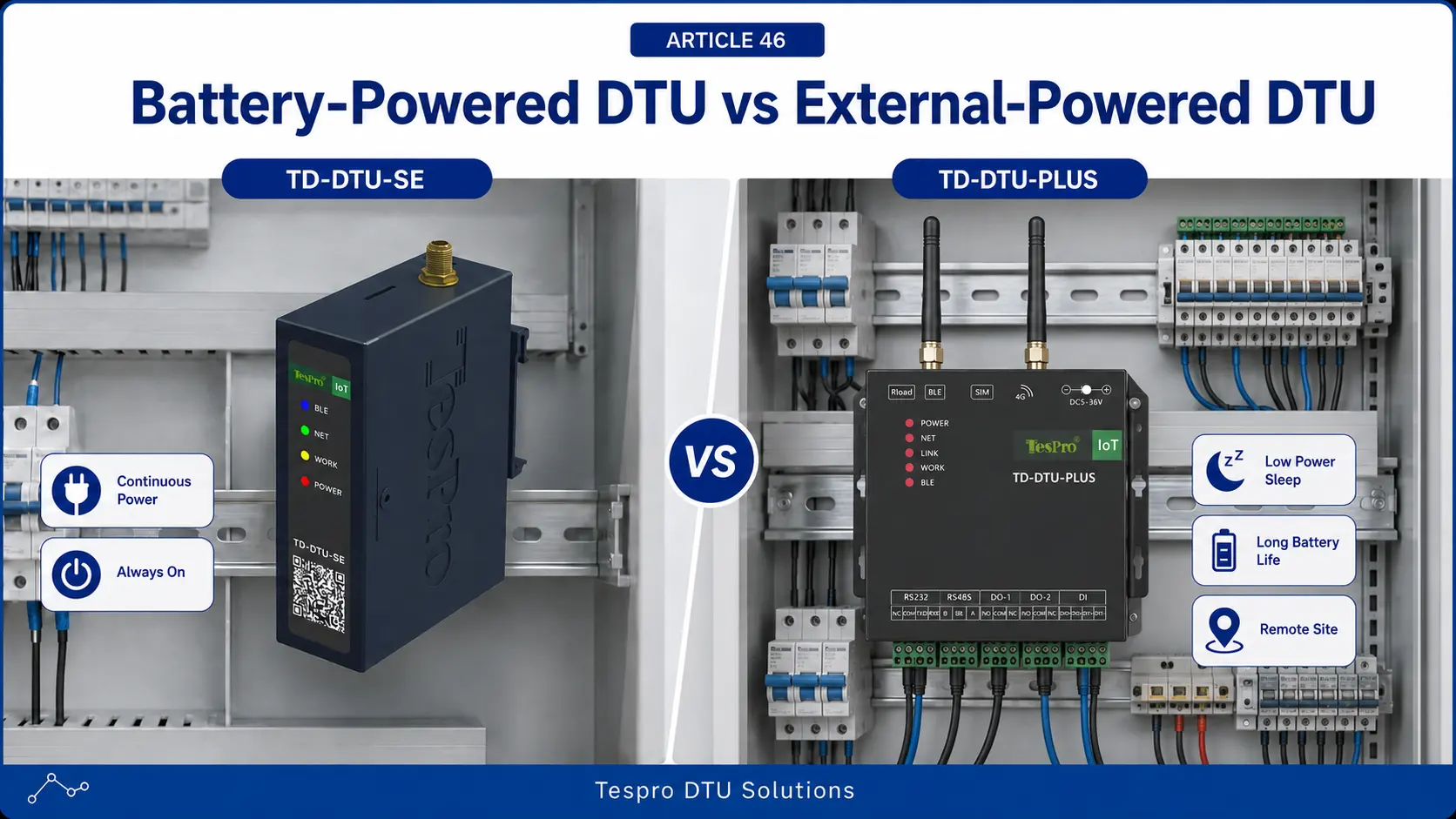

A battery-powered or backup-battery DTU fits unstable-power sites, short outage retention or low-frequency reporting. An externally powered DTU is better for continuous sessions, frequent communication and remote commands. Battery life depends on registration, signal, reporting interval, serial-device load, temperature and retries—not capacity alone.
Key Takeaways
• Backup-battery operation and ultra-low-power sleep are different designs.
• Weak signal and repeated reconnection increase power use significantly.
• Battery projects require a maintenance and replacement plan.
Choose by online behavior
A device that must receive server commands at any time normally maintains a connection and consumes more power. A sensor that reports hourly or daily may use periodic wake-up if the device and protocol support it.
Estimate life under worst conditions
Include boot peaks, network registration, retries, low temperature, battery aging and serial peripherals, not only average current. Calibrate laboratory estimates through field-cycle testing.
Battery safety and maintenance also matter
Define charging, temperature, transport, storage, lifetime, alarms and field replacement.
How Tespro Fits
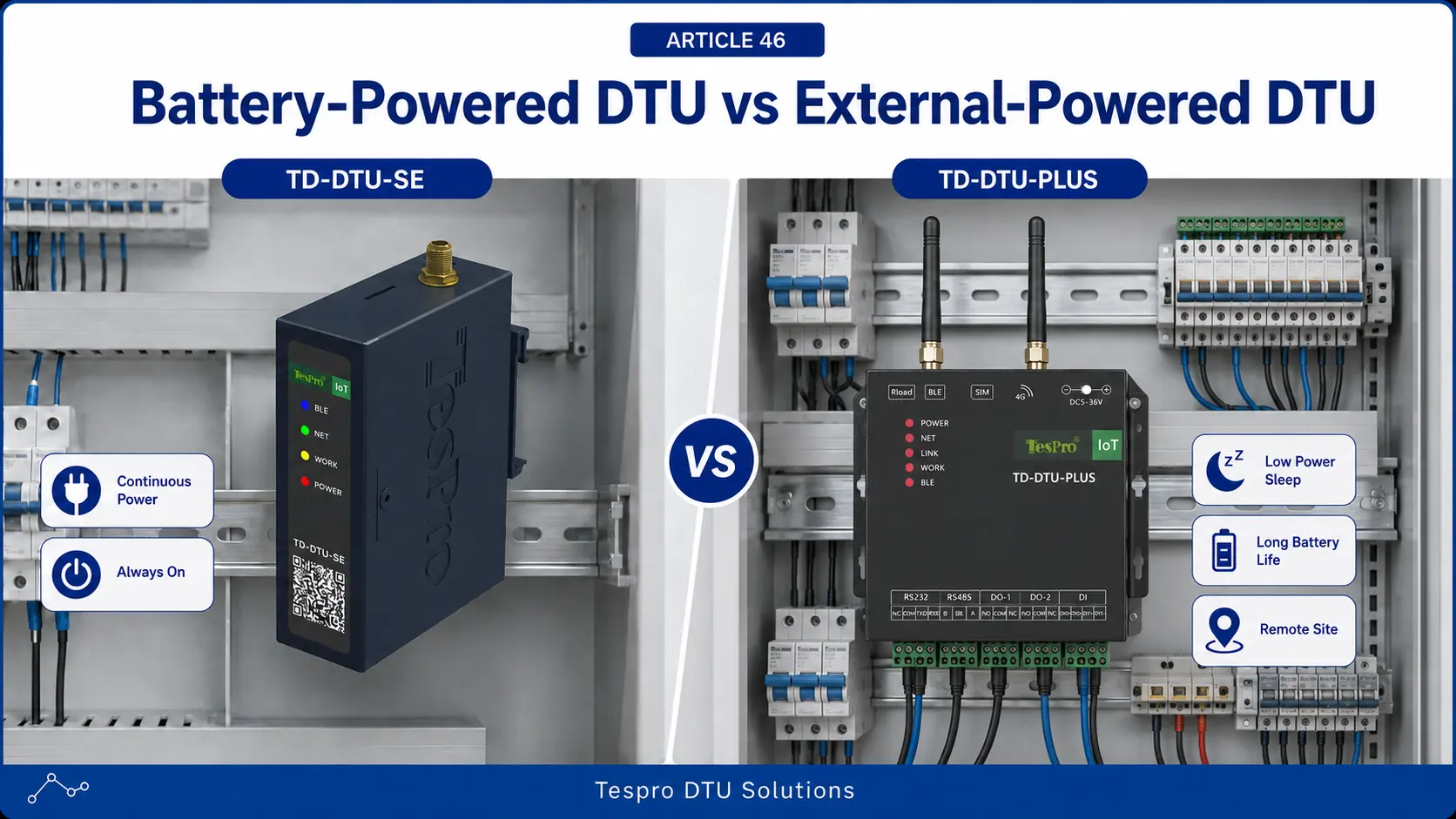
Tespro TD-DTU-SE, TD-DTU-PRO and TD-DTU-PLUS can be evaluated by interfaces, cellular generation, size, GNSS and backup-battery needs. TD-DTU-PLUS can be considered for projects requiring battery support, with life and operating modes confirmed by current documentation and test conditions.
Compatibility and Selection Checklist
✓ Availability of reliable external power
✓ Reporting interval and connection persistence
✓ Whether the server initiates commands
✓ Signal, registration and retry count
✓ Serial-device and peripheral power
✓ Temperature, battery life and replacement
Frequently Asked Questions
Q: How many days can a backup-battery DTU operate?
A: There is no universal answer. Calculate and test using capacity, mode, signal, reporting and temperature.
Q: Can a sleeping DTU receive commands at any time?
A: Usually not. A sleeping device communicates during wake windows, depending on design.
Q: Is a battery DTU suitable for video?
A: No. Video requires sustained bandwidth and power and should use an industrial router with stable power.