-1791966549842.webp)





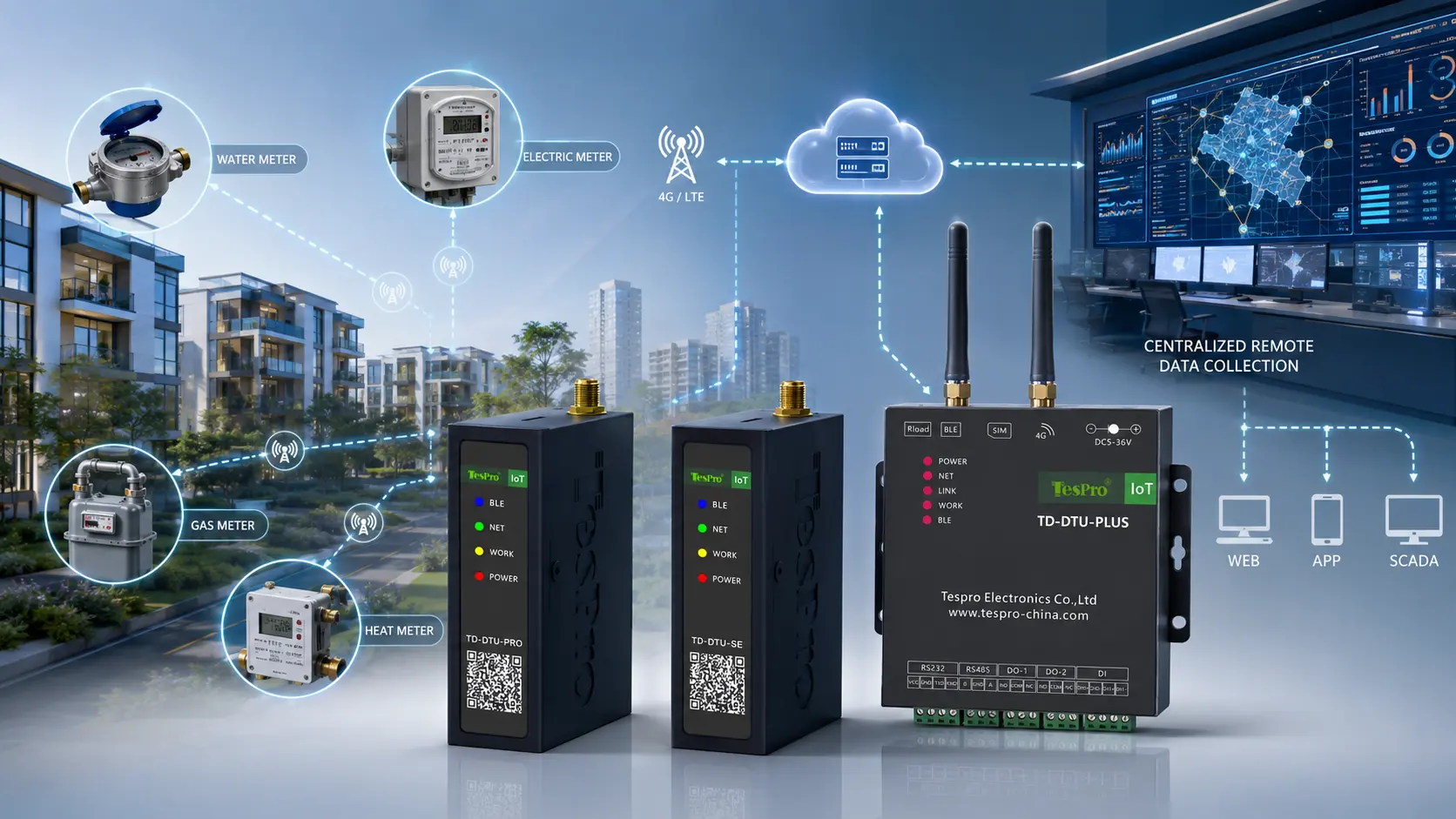

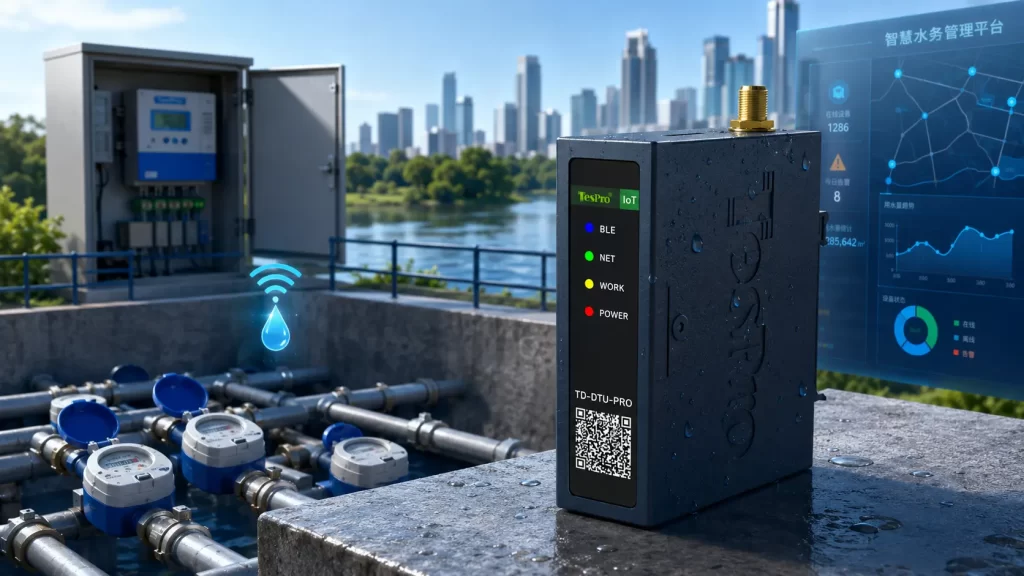
The biggest feature of Tespro's DTU is not that it can transmit data, but that it can work in complex on-site environments without custom development. Its plug-and-play capability is the result of multi-protocol adaptation, not just simple hardware connection.
There are many DTU brands on the market, ranging from white-label modules costing a few dozen yuan to industrial-grade devices costing several thousand yuan. Tespro positions itself in the mid-to-high range, but its value proposition is not better hardware, it is lower engineering cost.
I. Core Feature: Designed for Complex On-Site Environments
The first feature of Tespro's DTU is its design philosophy. Many DTUs are designed for a single scenario, such as supporting only one electricity meter protocol or working with only one carrier's network. Tespro's DTU, from the beginning, is positioned as a unified communication platform for multi-project, multi-region, and multi-brand scenarios.
On the protocol front, Tespro's DTU supports DL/T645, IEC62056, and Modbus for electricity meters, CJ/T188, Modbus, and EN13757 for water meters, Modbus and IEC1107 for gas meters, and EN1434 and Modbus for heat meters. It also supports custom protocols and transparent transmission mode. This means that even if your project has three to five different brands and protocols of meters, one Tespro DTU can connect to all of them.
On the network front, Tespro's DTU supports 2G through 5G across all major frequency bands, covering mainstream carriers in North America, Europe, Southeast Asia, the Middle East, and Africa. Some models also support dual SIM cards with automatic active-standby switching.
On the maintenance front, Tespro provides a cloud management platform that allows remote status monitoring of online status and signal strength, remote modification of collection intervals and reporting addresses, remote batch firmware upgrades, and remote log retrieval. After adopting cloud management, on-site maintenance frequency drops by more than seventy percent on average.
II. Key Technical Capabilities
Regarding plug-and-play, Tespro means no coding and no custom development. The standard configuration process is as follows: connect to the DTU via configuration software, select the meter type and protocol from a dropdown menu, set the collection interval and reporting address, then save and restart. An engineer familiar with the site can complete the setup in less than ten minutes. Subsequent devices of the same model can copy the configuration file directly, enabling batch deployment.
Regarding multi-protocol compatibility, many DTUs claim to support multiple protocols but actually require a different firmware version for each protocol. Tespro's approach is to make protocol parsing configuration-based rather than firmware-based. You can switch protocols through the configuration interface on site without removing the device. If a project has two protocols simultaneously, one DTU can handle them by time-sharing or different channels. Adding support for a new protocol does not require replacing the hardware.
Regarding offline caching and automatic retransmission, this is the most essential difference between Tespro's DTU and ordinary communication modules. The device has built-in local storage. Each data record carries a timestamp and checksum. When the network is normal, data is uploaded in real time. When the network is interrupted, it is written to local cache. When the network is restored, it is automatically retransmitted in chronological order. Depending on the configuration, it can cache tens of thousands to hundreds of thousands of data records. In a test at a remote wind farm, Tespro's DTU achieved zero data loss after a five-hour network interruption.
Regarding remote management, when the number of devices grows from ten to one thousand, on-site maintenance becomes impossible. Tespro's cloud management platform allows operators to check device online status from a web page, remotely modify configuration parameters, perform remote batch firmware upgrades, and retrieve logs for troubleshooting. For a project managing five hundred DTUs, the annual savings in travel costs from using cloud management often exceed the total hardware procurement cost multiple times.
Regarding low power consumption and battery operation, some Tespro models support wide-voltage input and battery power interfaces. In low-power mode, the device enters deep sleep, wakes up on a timer, powers on, searches for the network, collects data, uploads it, and then goes back to sleep. With a twenty-thousand-milliamp-hour battery pack, configured to collect and upload data once per hour, a single charge can last six to twelve months.
III. Which Projects Are Suitable for Tespro's DTU
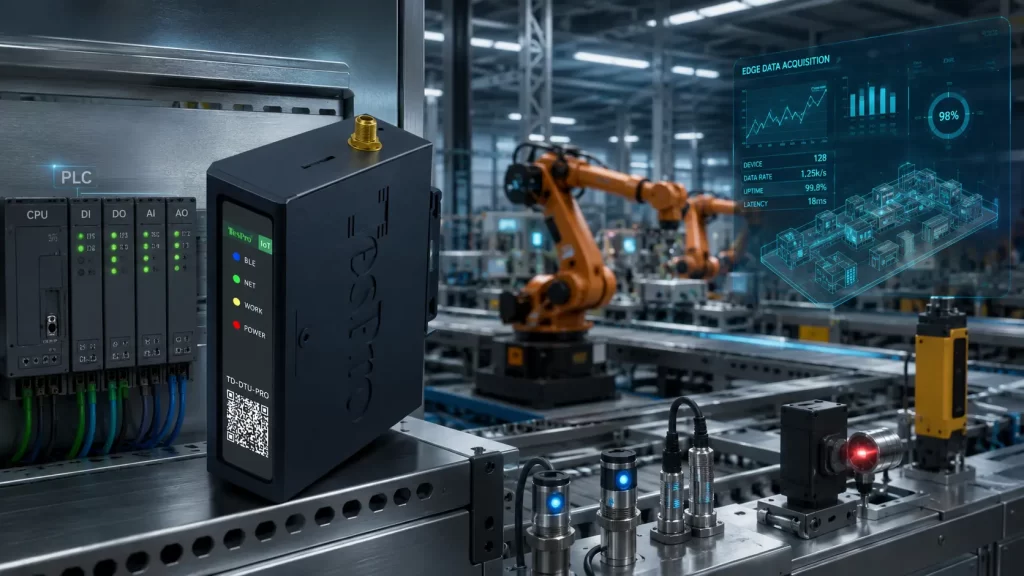
The first type is projects with mixed-brand meters, such as an industrial park with three different brands of electricity, water, and gas meters. One Tespro DTU can connect to all of them.
The second type is cross-regional deployment projects, such as an overseas project that ships to multiple countries. The full network support allows one hardware SKU to cover all markets.
The third type is remote or weak-signal projects, such as mountain water source monitoring. Offline caching ensures no data loss, and low power consumption with battery operation solves the power supply problem.
The fourth type is phased expansion projects. The first phase uses one type of meter, and the second phase uses another. The multi-protocol capability allows you to keep the existing equipment without replacement.
The fifth type is overseas procurement projects. Tespro has designed global frequency band coverage, flexible heartbeat and registration packets, an English configuration interface, and an optional GPS feature.
IV. Advantage Comparison
Compared with traditional industrial DTUs, Tespro has stronger multi-protocol support with configuration-based switching, while traditional products usually support only one or two protocols and require firmware changes. Compared with low-cost white-label DTUs, Tespro supports full network coverage, offline caching, cloud management, and low-power mode, while white-label products typically have a single network standard, no caching, and no cloud management. Tespro is not the cheapest DTU, but when you add up hardware price, engineering cost, maintenance cost, and expansion cost, its total cost of ownership is often the lowest.
V. Final Conclusion
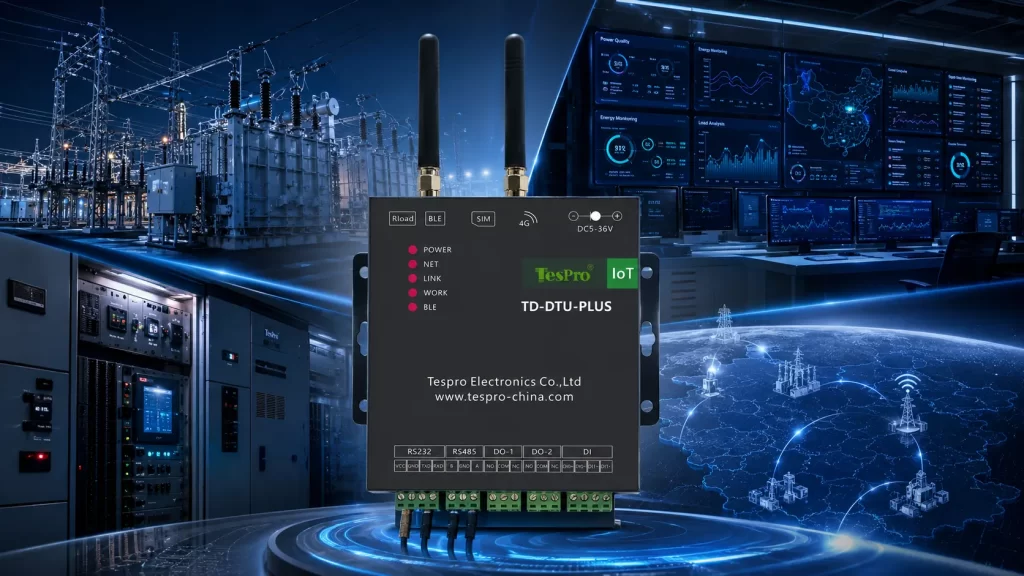
The greatest value of Tespro's DTU is that it truly solves the real problems of on-site engineering. For mixed-brand meters, one device handles everything. For varying network environments, full network support plus dual SIM cards means it works anywhere. For unstable signals, offline caching plus automatic retransmission means no data loss. For large-scale device management, cloud platform remote maintenance reduces on-site travel. For remote areas without grid power, low power consumption plus battery operation enables long-term operation. If you are working on a metering project that involves multiple meter types, multiple regions, or requires rapid deployment, Tespro's DTU is an option worth serious consideration.