-1791966549842.webp)





In 2025, the global AMI market was estimated to be valued at 25.06 billion USD. This market is expected to be worth 71.41 billion USD by 2034. This market is expected to grow at a compound annual growth rate (CAGR) of 11.6%. As utility companies and smart grid operators invest more in their own infrastructure, the choice of Industrial Router Wholesale partner has grown from just being a line item on a Bill of Material (BOM) to a critical strategic procurement decision.
A communication backbone supports AMI and AMR deployments and becomes invisible until it fails. Routing the thousands of meter endpoints in different service areas presents bulk buyers with a real challenge, and that challenge is finding a wholesale partner that offers volume pricing along with customer service grade reliability, industrial grade multi-protocol support, and supply chain assurance.
This is where the direct supply model provides clear benefits.
The Importance of Direct Industrial Routing for AMI Backhaul
Direct routing from a manufacturer as opposed to a trading intermediary alters the procurement landscape in a number of areas:
• Transparent Cost Structures: With direct wholesale, utilities and system integrators avoid paying for middle-tier markups. Partly as a result of this, they budget for endpoints and security more than others.
• Identical Firmware Across All Devices: Clients that buy in large quantities receive the same firmware, which simplifies both deployment and the management of the devices from a distance.
• Quicker Return Merchandise Authorization (RMA) and Tech Support: Improved relationships with the manufacturers means better and faster RMAs and improved and faster technical support. This becomes essential if a backhaul link goes down and negatively affects thousands of meters.
• No Limits on Customization Volume: The customization options we offer are extensive. We pre-configure our transportation protocol stacks, Modbus, DNP3, IEC 60870-5-104, and undertake our SIM provisioning just in time before we ship, which significantly lessens our time onsite.
Important Items to Note Regarding the 2026 AMI Backhaul Rollout
With the shift from AMR to AMI, the backhaul requirements also change. Based on an IEEE Smart Grid article, certain utility applications like EV charging can require 10 to 50 times more bandwidth in comparison to standard AMI endpoints. For those wholesale buyers assessing their options for industrial routers, three specific core features have gone from being optional to absolutely required.
1. Real Network Redundancy
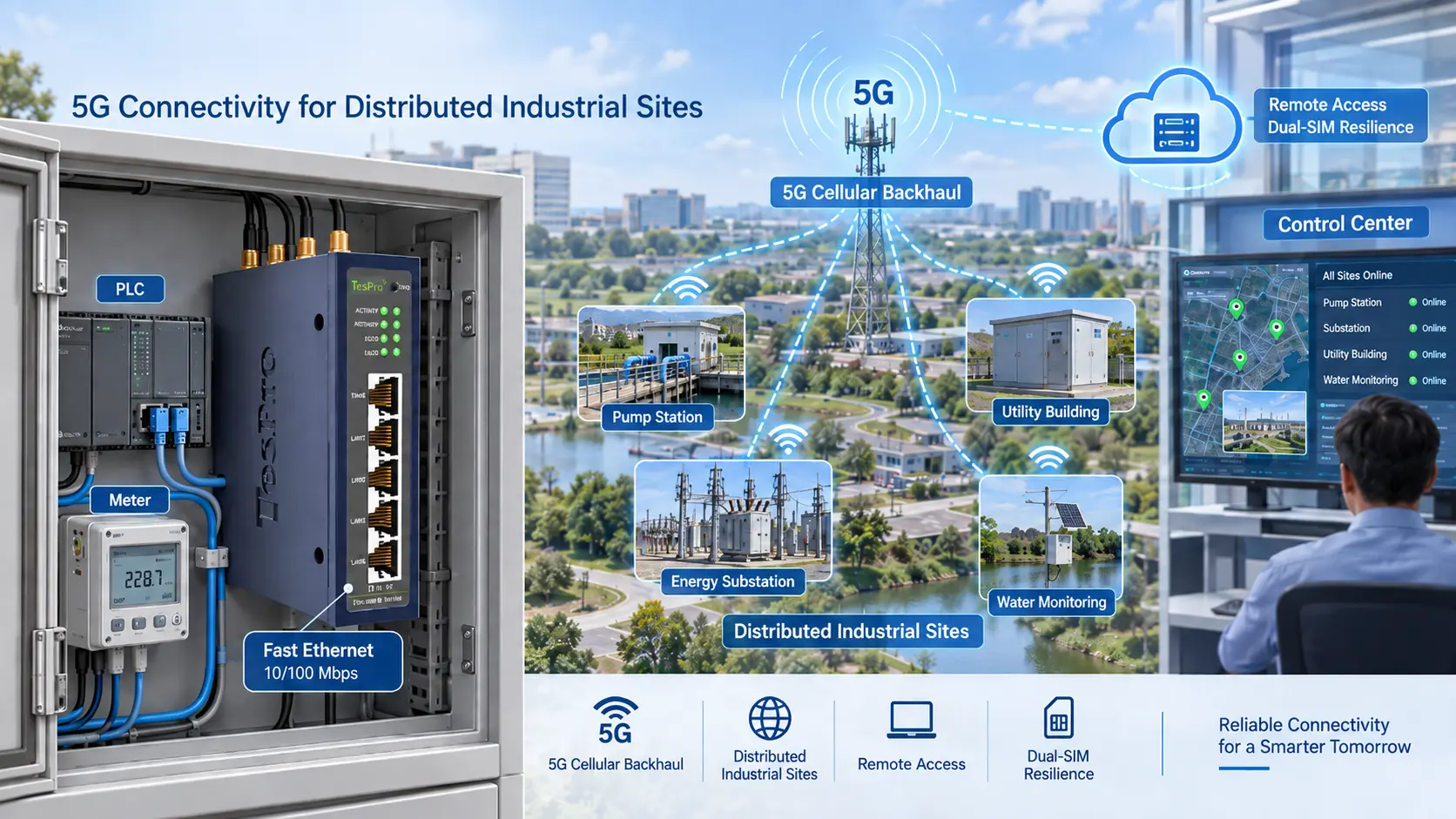
The AMI backhaul is unable to deal with blackouts. Dual SIM with Auto-Failover as a Back-up Carrier combined with Wired Back-up Paths ensures that even when the primary carrier's cellular network degrades, the backhaul links will continue to push back metering data to the head-end, providing the utmost network reliability. It is essential to maintain revenue-grade metering data, regardless of season, weather, or carrier outages. This is not a theoretical exercise.
2. Serial-to-IP Bridging for Legacy Meter Assets
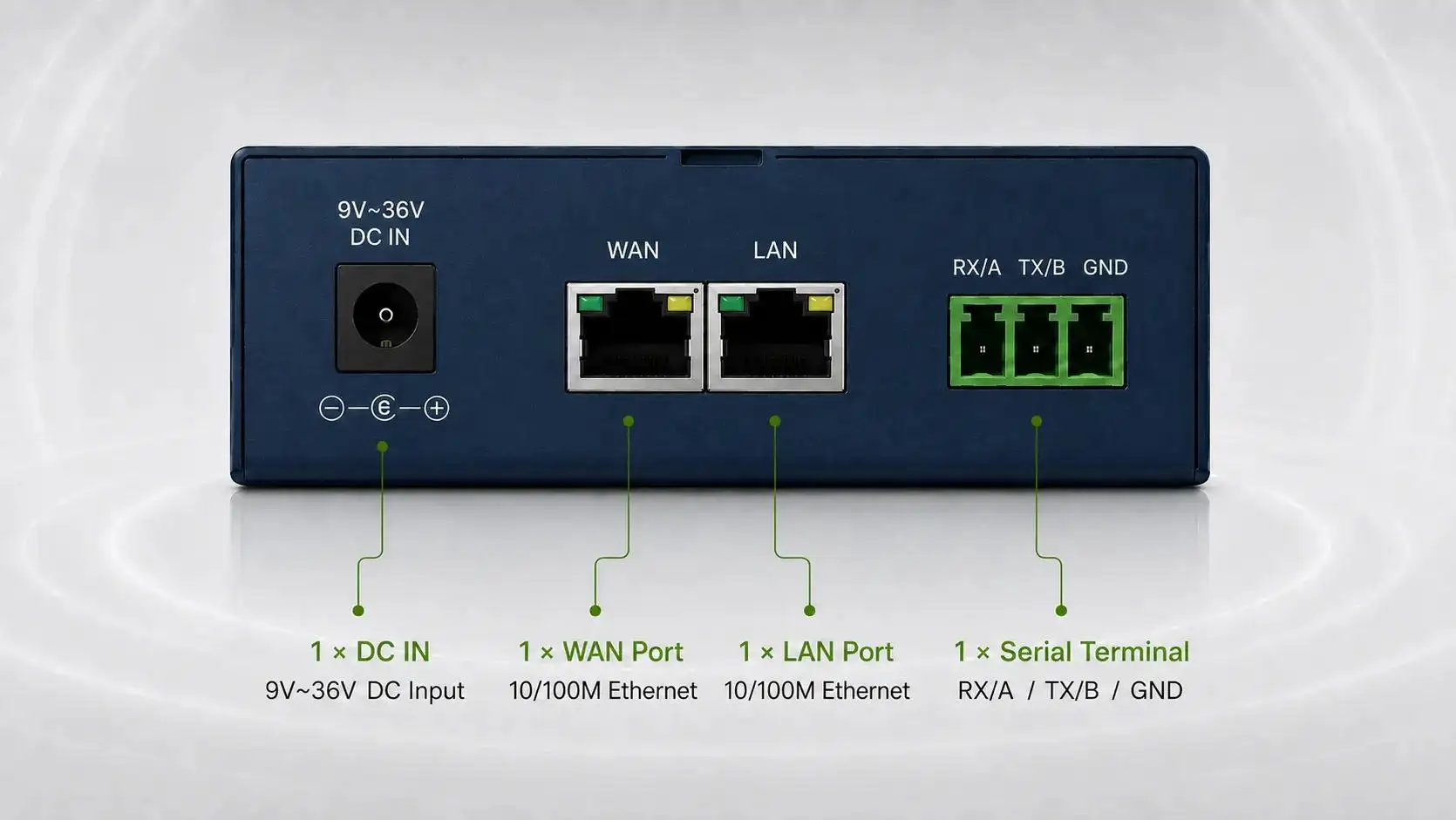
Modern smart meters speak IP, but millions of existing endpoints in the field still rely on RS485 and RS232 interfaces. Industrial routers that natively bridge serial protocols (Modbus RTU, DNP3 serial, CJ/T 188-2004) to IP networks protect capital investments while enabling two-way AMI functionality without forklift upgrades.
3. Hybrid Connectivity Architecture Support
Utilities are increasingly adopting layered, hybrid communication networks that match the right transport to each use case—RF mesh for low-power endpoints, cellular for high-bandwidth backhaul, and private LTE for latency-sensitive distribution automation. Wholesale industrial routers must support this architectural flexibility without forcing lock-in to a single connectivity standard.
Why Tespro's TR Series Meets the 2026 AMI Needs
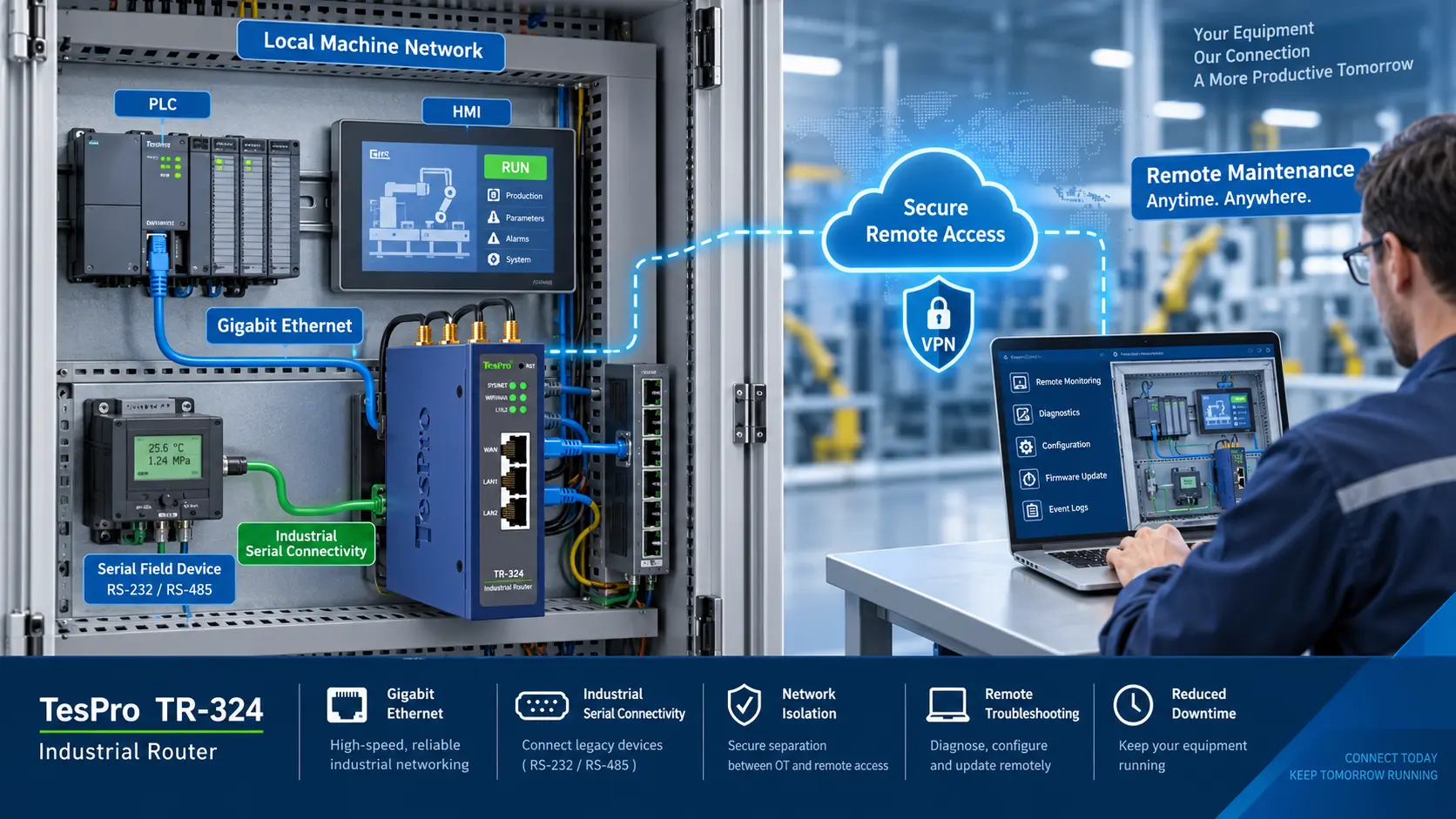
Started in 2002, Tespro began making communication devices, but now makes Industrial IoT communication devices supplied to Fortune 500 companies in the global systems of utilities and smart cities. The TR Series industrial cellular routers are made for AMI/AMR backhaul environments.
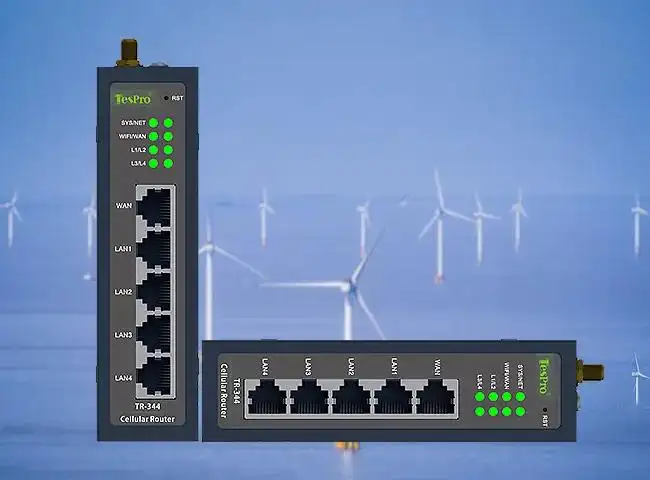
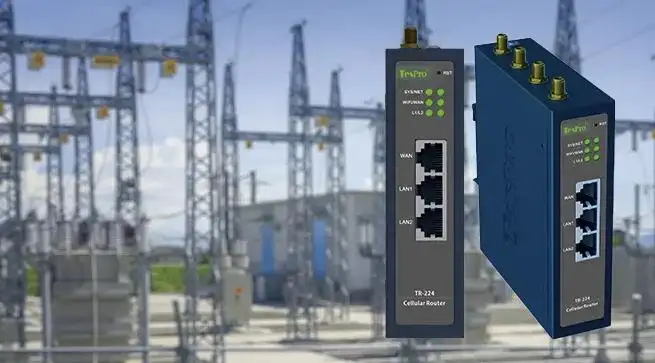
The range of products has seven different models in 4G and 5G, from the small TR-224 (4G LTE, 2×100Mbps LAN ports, RS485+RS232) to the powerful TR-345 (5G LTE, 4×1000Mbps LAN ports, dual RS485+RS232). For the wholesale buyer, TR Series routers provide three infrastructure benefits:
1) Industrial Ruggedness
All products in the range are rated for operating in the field from -40°C to 75°C, with a wide-voltage DC input (5-30V) and a Dual Path Supply (DCS) (DC jack & DC terminal block) and can be mounted on a DIN rail. All of these specifications are the result of the conditions of the utility cabinets, substations, and even outdoor pole enclosures where the routers are installed.
2) Multi-Protocol Serial Connectivity
Each model has both RS485 and RS232 ports so wholesale buyers can simplify their inventory and ensure their routers meet compatibility needs.
3) Scalable Remote Management
The management of devices is simplified by using a cloud platform. This control includes the ability to do batch updates of firmware and to set devices in place. This is the only way to change the configuration of a large number of routers used to meet the needs of a large regional AMI deployment.
Choosing Wisely for Your AMI Program
When you are thinking about Industrial Router Wholesale partners for AMI backhaul, it is important to look at the total cost of connectivity, not just the cost per router. The right wholesale partner provides documented compliance with industrial certifications (operating temperature verification, EMC testing reports), component traceability, and demonstrated mean time between failure (MTBF) metrics exceeding 100,000 hours.
Direct manufacturers with established quality management systems and transparent supply chains deliver the consistency that large-scale metering programs require—because in AMI deployment, the last thing any project needs is a connectivity bottleneck from the one component that was never supposed to fail.
Tespro. Direct supply for industrial connectivity that keeps meters reporting.
FAQ
Q: What is the minimum order quantity (MOQ) for Industrial Router Wholesale pricing?
A: Minimum order quantities for wholesale pricing are 50-100 units. However, with Tespro, as a direct manufacturer, you have the advantage of tiered discounts based on your annual volume commitments.
Q: Can I order wholesale routers that are pre-configured to certain AMI protocols and shipped to my doorstep?
A: Absolutely! This is a common practice for many wholesale suppliers. You can even find factory pre-loading of Modbus, DNP3, IEC 104, or CJ/T 188 protocol stacks, so that is one less thing you have to configure on site.
Q: What changes with direct wholesale to warranty and RMA turnaround?
A: With direct wholesale, you have the standard 2–3 years warranty with advanced replacements for volume buyers. In addition, you have direct technical escalation to your vendor with no distributor delays.
Q: Are 5G routers required for AMI?
A: Not necessarily, as for most AMI backhaul, 4G LTE would suffice. Not only that, but both the TR-245 and the TR-345 5G models will have high bandwidth capabilities and will also create a future proof network for use cases that involve distribution automation, as well as substation video streaming.
Q: What documents do I need to ask for before placing a wholesale order?
A: You will need reports for temperature chamber testing, certificates for EMC/EMI compliance, MTBF calculation sheets, and batch traceability for the components.