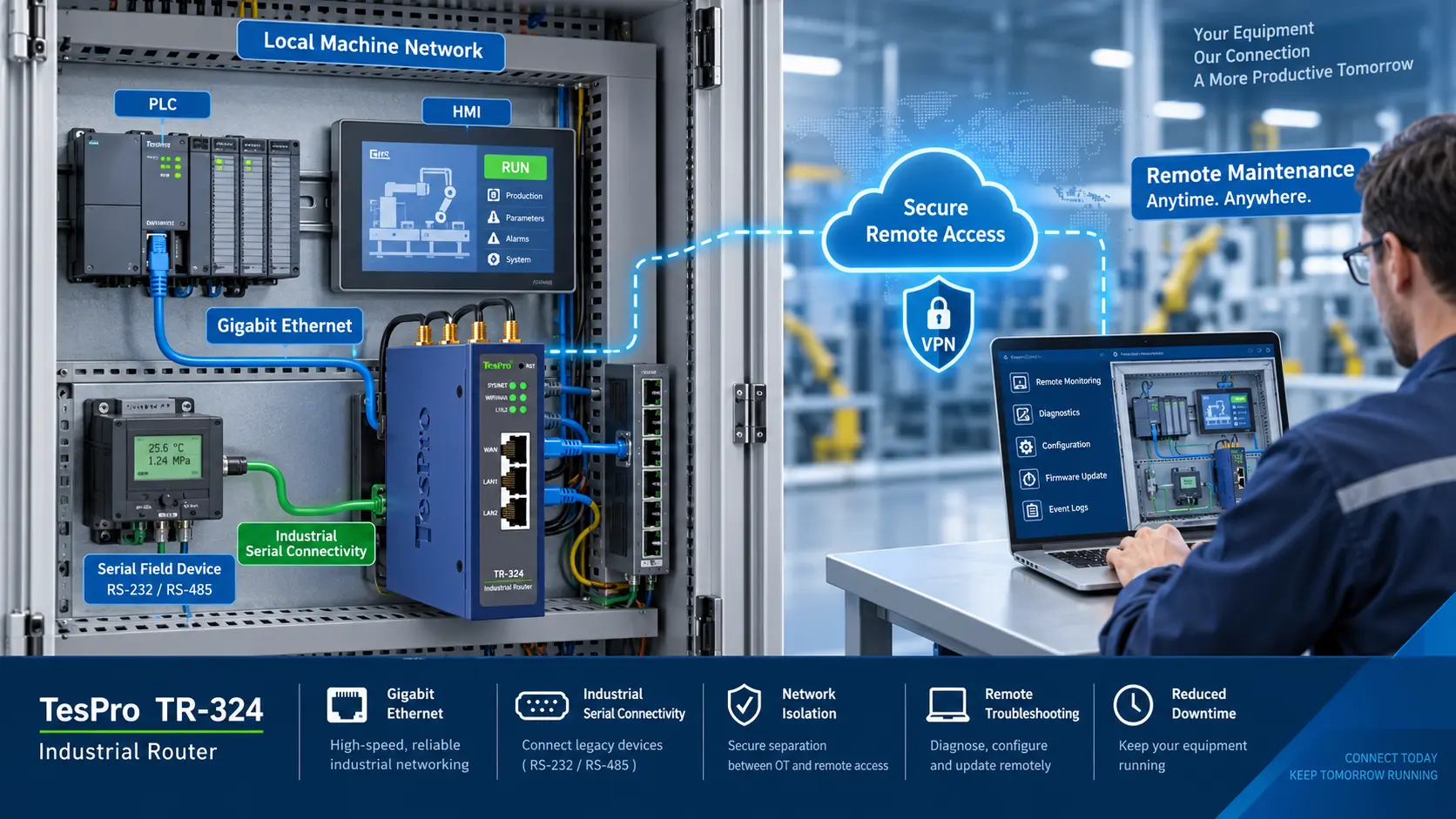
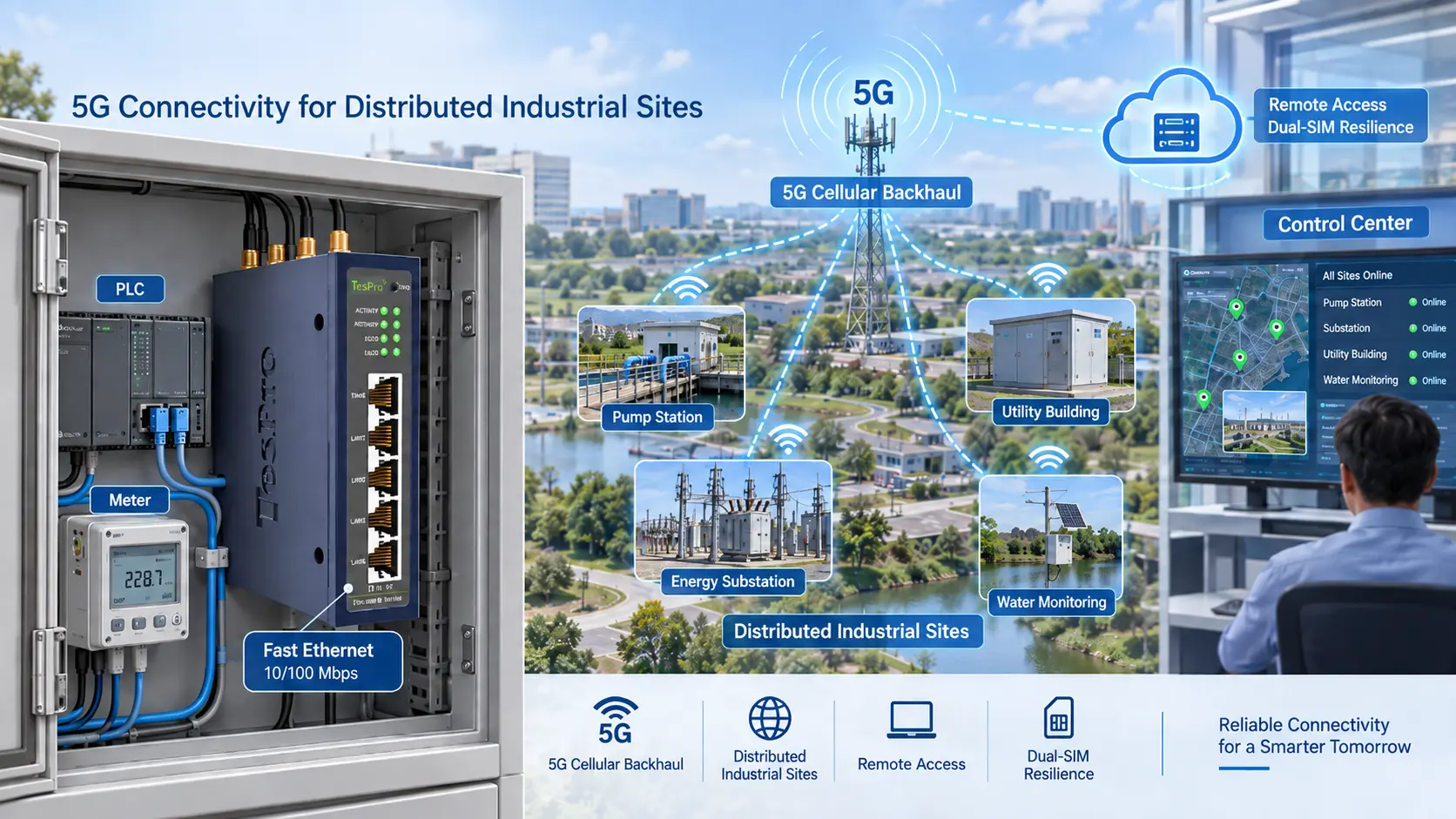
-1791966549842.webp)







For Industrial Router Supplier, sourcing is a thing of the past. For buyers in utilities, industrial automation, and smart infrastructure, it is a matter of uptime. Unpredictable and unstable power, shifting temperatures, and changing network conditions can increase weak connectivity, latency alarm triggers and increase the cost of services.
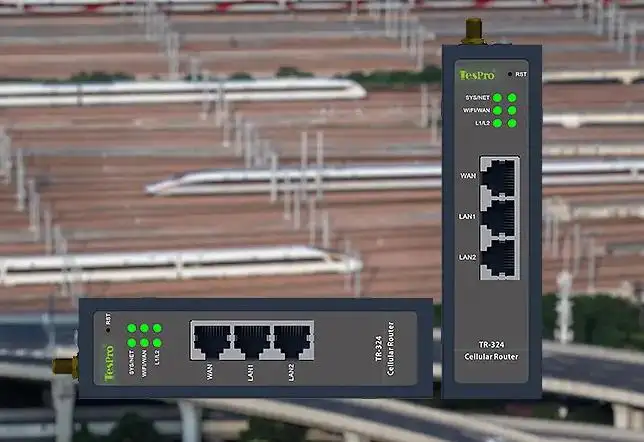
Tespro solves this with industrial connectivity redundancy, including 2G-5G, Ethernet, Wi-Fi, dual SIM, failover, VPN, remote management and cloud support. This makes its routers well suited for AMI/AMR, smart utilities, campus networks, and smart city deployments.
Why Uptime Has Become the Real Buying Standard
Industrial IoT projects are scaling into environments where a basic commercial router is not enough. Buyers now expect one device to support always-on communication between field assets and cloud platforms, while fitting into broader digital programs that include remote monitoring, automation, predictive maintenance, and distributed control. GSMA notes that connected manufacturing and private mobile technologies are becoming central to productivity and resilience, while recent industry coverage continues to point to 5G, edge connectivity, and industrial digitalization as active growth areas.
This shift changes buying priorities. Overseas procurement teams are not only comparing bandwidth or interface counts. They are asking harder questions:
• What happens if the primary carrier signal drops?
• Can the router recover automatically without site intervention?
• Will it operate reliably in cabinets, substations, roadside enclosures, or solar installations?
• Can IT teams manage fleets remotely and securely?
• Does the supplier understand utility and industrial protocol environments?
That is where an industrial-grade router supplier starts to separate itself from a general networking vendor.
Why do many projects choose an industrial router instead of a regular commercial router?
In real-world environments like utilities, roadside cabinets, or remote sites, network conditions are often unstable. Tespro industrial routers are designed to keep connections running continuously, even when signals fluctuate or power conditions change, which helps avoid downtime and service interruptions.
The Core Feature That Deserves More Attention: Redundant Connectivity
Tespro's strongest commercial angle is not simply that it offers 4G or 5G. The more valuable point is that its router platform is built around redundancy and recovery. On its industrial router pages, Tespro emphasizes dual SIM, failover, Ethernet and Wi-Fi connectivity, VPN support, cloud management, and industrial integration support. Its product materials also describe wide temperature tolerance, wide voltage input, and rich serial and LAN interfaces for field deployment.
For buyers, that matters because redundancy reduces the operational cost of uncertainty. A well-chosen industrial router should help a project continue running when one link becomes unstable or one power condition changes. In practical terms, this can support:
• More stable telemetry from remote devices
• Faster recovery after carrier-side interruptions
• Lower dependency on manual resets or dispatches
• Better continuity for alarms, logs, and control signals
• Cleaner integration between field equipment and cloud software
This is especially relevant in smart metering, distributed energy, traffic systems, water networks, and remote industrial assets, where connectivity loss can quickly turn into service disruption or data gaps.
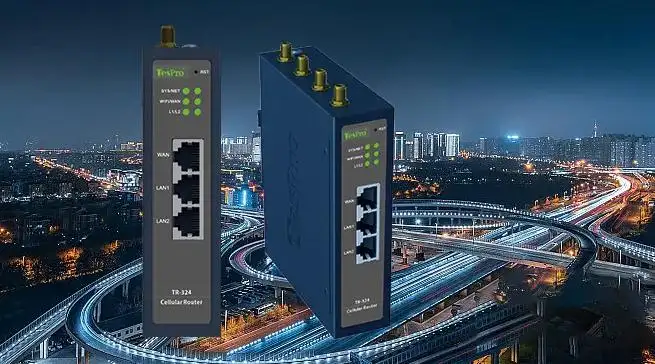
What happens if the network signal becomes unstable or drops?
Tespro industrial routers are built with redundancy features such as dual SIM and automatic failover. If one network connection fails, the router can switch to another available network, helping maintain continuous data transmission without manual intervention.
How Tespro Fits Current Market Direction
Tespro's positioning aligns well with where industrial connectivity is moving. The company combines industrial routers with broader communication and software capabilities, including IoT devices, edge communication equipment, and cloud platform services. Tespro states that its industrial routers are designed for communication between devices and the cloud, and that its software offerings support remote monitoring, configuration, and data management.
That matters because buyers increasingly want fewer integration layers. Instead of patching together separate hardware, transmission logic, and management software from multiple vendors, many projects prefer a more unified path from field device to application platform.
Tespro's technical direction also reflects broader industry demand in three ways.
1. Support For Multi-Network Reality
Industrial sites are rarely uniform. Some depend on cellular first, some use wired backhaul where available, and many operate in mixed conditions. Tespro's router materials emphasize support for cellular generations from 2G to 5G, plus Ethernet and Wi-Fi options, which is useful for phased upgrades and mixed network environments.
2. Fit For Harsh Operating Conditions
Tespro highlights wide operating temperature design, wide voltage input, DIN-rail installation, and industrial-grade protection on its router pages. These are not cosmetic details. They are often the difference between lab-ready hardware and field-ready hardware.
3. Cloud And Remote Management Readiness
Remote fleet management and visibility are quickly becoming standard expectations in industrial deployments, rather than high-end additions. Tespro presents cloud management and software platform support as key advantages, enabling centralized administration, lighter maintenance requirements, and stronger long-term lifecycle control.
Is it easy to manage multiple industrial routers deployed in different locations?
Yes. Tespro provides remote management and cloud support, allowing teams to monitor, configure, and maintain devices centrally. This is especially useful for projects with distributed assets, as it reduces the need for on-site maintenance.
A Better Fit For Utilities, Smart Cities, and Distributed Assets
One reason Tespro is commercially credible in this segment is that its industrial communication business is closely tied to utility and IoT communication scenarios. The company describes experience in communication equipment for electricity, gas, and water applications, with in-house hardware and software capabilities and a focus on real-time data collection and smart management.
That background helps when buyers need more than a generic industrial router. In sectors such as AMI/AMR, smart campuses, renewable energy, and municipal infrastructure, the router must sit inside a larger data workflow. It is not just passing packets. It is supporting visibility, accuracy, response speed, and operating efficiency.
Tespro also showcases project use cases, including a published case about large-scale router deployment for solar grid monitoring in the Middle East, which reinforces its relevance for distributed energy and remote monitoring applications.
How does Tespro’s redundant connectivity design improve network stability?
Tespro industrial routers integrate dual SIM, failover mechanisms, and support for multiple network types such as cellular, Ethernet, and Wi-Fi. This design allows the router to automatically switch connections when one becomes unstable, maintaining continuous data transmission in real-world industrial conditions.
What Overseas Buyers Should Check Before Choosing an Industrial Router Supplier
A professional sourcing decision should go beyond headline speed claims. Buyers should verify if the supplier can adapt to the practical requirements of field networking.
• Continuity Design: dual SIM capability, automatic failover, and multiple connectivity routes.
• Environmental Performance: reliable operation across temperature shifts, humidity exposure, voltage fluctuation, and enclosure limitations.
• Interface Options: flexible LAN, serial, and protocol integration for different field requirements.
• Remote Security: VPN support and protected remote connection access.
• Management: via remote maintenance or cloud.
• Deployment: suitable for DIN-rail, space-saving, and industrial cabinet integration.
• Industry knowledge: utilities, automation, or smart infrastructure.
Tespro excels in these areas, particularly providing buyers the rugged communication layers needed to integrate field devices and cloud services while maintaining simplicity throughout the system.
Final Thought
For today's industrial buyer, the best Industrial Router Supplier is not the one with the most aggressive speed label. It is the one that helps keep data flowing when site conditions are imperfect and project scale starts to grow.
That is why Tespro's most persuasive feature is its focus on reliable redundant connectivity. With dual-SIM failover, multi-network support, rugged industrial design, VPN capability, and cloud-oriented management, Tespro is aligned with the direction of modern industrial IoT: more remote assets, more real-time decisions, and less tolerance for communication failure.
FAQ
1. What Does An Industrial Router Supplier Actually Provide Beyond Hardware?
A professional Industrial Router Supplier should provide more than just the router itself. Buyers usually need support for deployment planning, connectivity matching, remote management, security configuration, and long-term maintenance. In industrial IoT projects, supplier capability often matters as much as product specifications.
2. Why Is Redundant Connectivity Important In Industrial Router Projects?
Redundant connectivity helps keep communication active when one network path becomes unstable or unavailable. Features such as dual SIM, automatic failover, Ethernet backup, and Wi-Fi support can reduce downtime, protect data continuity, and lower the need for manual intervention in remote sites.
3. What Industries Commonly Need An Industrial Router Supplier?
Industrial routers are widely used in utilities, AMI/AMR systems, smart grid projects, smart city infrastructure, traffic systems, renewable energy, water treatment, industrial automation, and remote asset monitoring. These applications often require stable communication in environments where consumer-grade devices are not suitable.
4. How Is An Industrial Router Different From A Commercial Router?
An industrial router is designed for tougher field conditions. It usually supports wider temperature ranges, broader voltage input, stronger enclosure protection, industrial interfaces, and more reliable remote communication recovery. A commercial router may work in an office, but it is often not built for substations, roadside cabinets, or unmanned outdoor installations.