-1791966549842.webp)






The cost of unplanned downtime is extremely high. According to statistics, unplanned downtime costs U.S. manufacturers between 5,000 and 50,000 dollars per hour, with larger facilities losing up to 532,000 dollars per hour. For the world's 500 largest firms, total operational technology downtime amounts to 1.4 trillion dollars annually. A significant portion of these failures originate from single points of connectivity — when the only cellular network signal degrades, the only carrier experiences a network outage, or the only power supply line is interrupted, the entire system goes down. Tespro's 4G LTE industrial routers fundamentally solve this problem through multi-link redundancy design, automatically switching between multiple communication paths to ensure that even if one link fails, data continues to flow smoothly.
Multi-link redundancy specifically includes three levels. First is dual-SIM failover — the router has two SIM card slots that can hold SIM cards from two different carriers. When the primary carrier's network becomes unreachable or signal strength drops below a set threshold, the router automatically switches to the backup carrier without any on‑site intervention. Second is triple link backup — the router simultaneously supports cellular, Ethernet, and Wi‑Fi connections, continuously monitoring the status of each link. When an issue occurs on the primary link, the router automatically switches to an available backup link according to preset policies. For example, in a factory floor environment, you might configure priority for wired Ethernet, switching to 4G cellular when wired fails, and then to Wi‑Fi if cellular also fails. Third is dual‑standby power inputs — the router supports both DC power jack and terminal block power connections. Even if one power connection fails, the other continues to supply power, ensuring the router does not go down due to power failure.
What is multi-link redundancy, and how does dual-SIM failover minimize downtime
Multi-link redundancy means the industrial router can switch between dual SIM cards, wired Ethernet, and Wi‑Fi whenever any available connection fails. Dual-SIM failover maintains signal monitoring for two carrier SIM cards simultaneously. When the primary SIM card loses signal, the second SIM card activates within seconds to keep the system online, eliminating costly on‑site service visits.
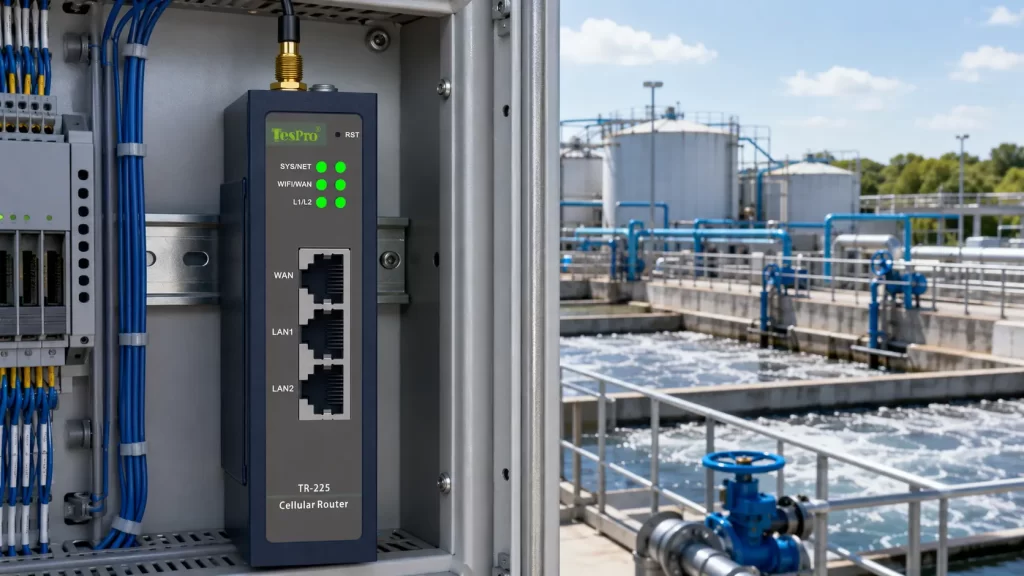
The core logic of this redundancy design is simple and effective: when carriers and transport media are diversified, the probability of failure across all paths becomes lower than the probability of failure of any single path. In real deployments, Tespro routers also feature a built‑in watchdog timer that automatically resets the router upon software or connection hangs, further reducing expensive field service needs. For applications such as smart metering, factory automation, and remote monitoring that cannot tolerate communication interruptions, this multi‑layer redundancy design directly translates into measurable uptime gains and operational cost reductions.