-1791966549842.webp)







Industrial Cellular Router for IoT is no longer judged only by signal access or data speed. For overseas buyers in utilities, smart infrastructure, industrial automation, and remote asset monitoring, the bigger issue is how to keep field devices online when power quality fluctuates, wired access fails, or carrier conditions change without warning.
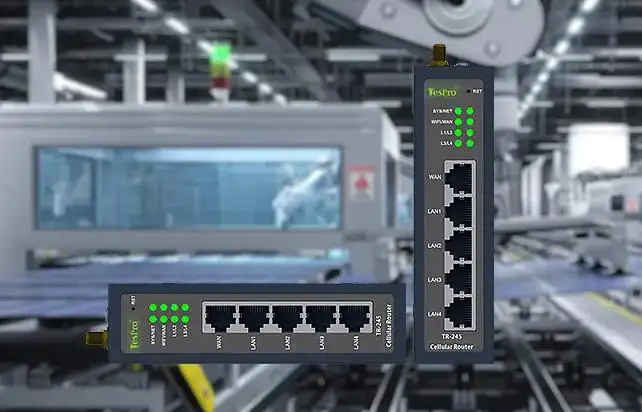
That is why network redundancy has become one of the most important buying criteria in industrial connectivity projects today. As cellular IoT expands and broadband-critical IoT connections continue rising globally, buyers are placing more value on resilient edge networking, secure remote access, and scalable management than on raw hardware specs alone.
The Real Challenge Is Not Connection, But Continuity
Many industrial sites already have coverage. The real problem is continuity under imperfect conditions.
A remote meter cabinet, roadside controller, pump station, campus energy node, or smart city cabinet may face:
•Unstable cellular conditions
•Temporary carrier-side disruption
•Power variation in the field
•Limited IT support on site
•Mixed legacy and modern device protocols
•Rising requirements for cybersecurity and remote visibility
In these environments, a lost connection is rarely just an IT inconvenience. It can delay data collection, interrupt AMI or AMR communication, reduce visibility for operators, and slow field response. For procurement teams, this means the router at the edge is now part of operational risk control, not just a communications accessory.
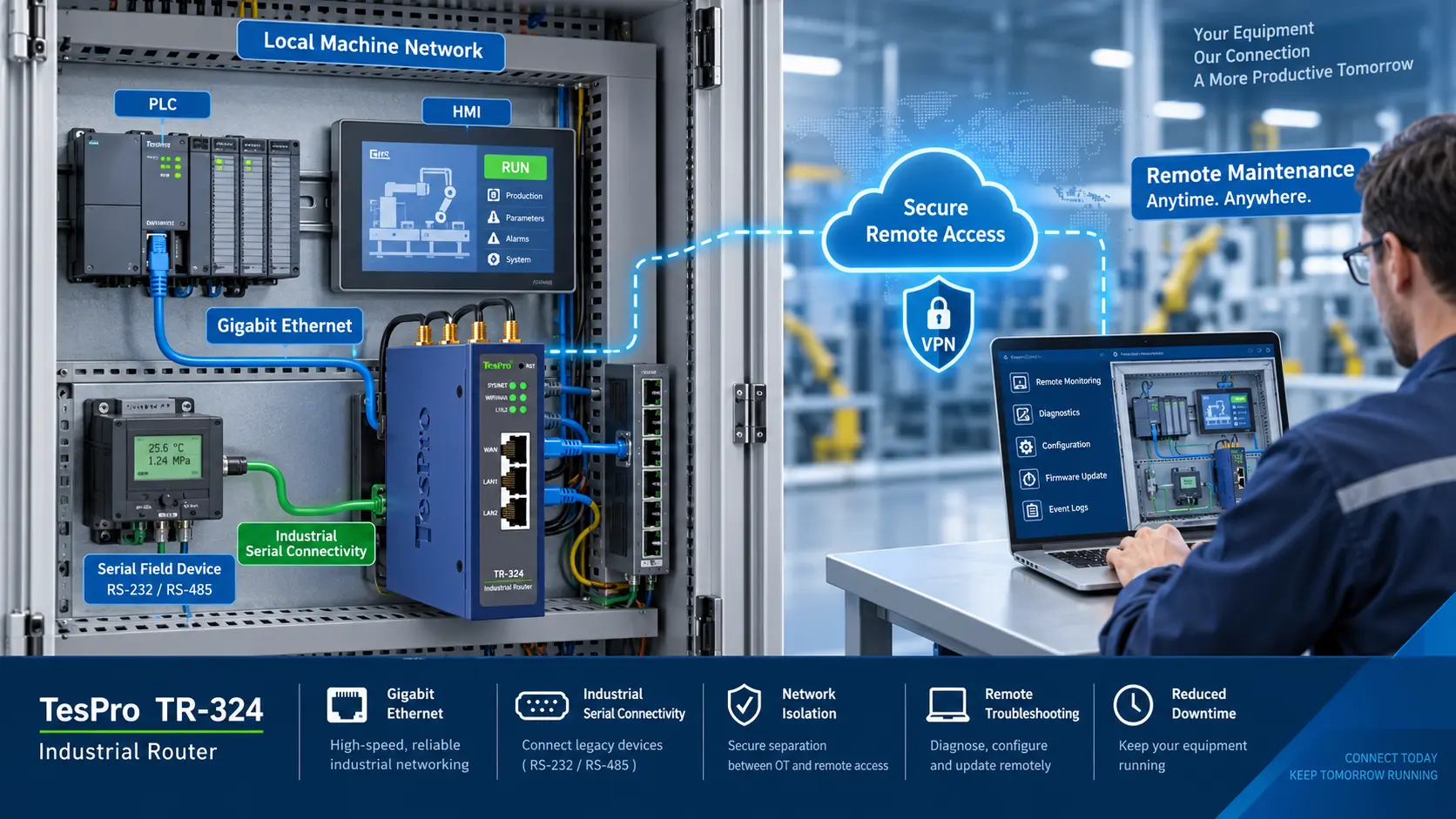
Tespro's industrial router portfolio focuses on multi-network accessibility, dual SIM, failover logic, VPN, serial and Ethernet interfacing, and cloud-based remote management, among others. This is how Tespro's approach aligns perfectly with the existing demand. Tespro also positions these routers for AMI, AMR, utilities, campuses, and smart city scenarios where stable device-to-cloud communication matters every day.
Why Network Redundancy Has Become the Main Feature
In industrial IoT, redundancy is no longer a premium feature added for special projects. It is becoming a baseline expectation.
Tespro offers detailed descriptions of its products to underline its redundancy-oriented connectivity design. This includes design flexibility and support for 2G to 5G networks, dual SIM standby, failover, Ethernet and Wi-Fi, and remote management streamlining. Some of Tespro's products also offer a special triple-path switching logic over wired, Wi-Fi, and cellular connections, as highlighted on select product pages. This feature directly addresses one of the most frequent sources of downtimes: reliance on a single transport path.
As a professional Industrial Cellular Router for IoT manufacturer based in Tespro provides rugged, high-reliability industrial cellular routers for global IoT projects, supporting OEM/ODM customization, global certification, and stable cross-border supply. Our Tespro Industrial Cellular Router for IoT is widely used in unattended sites, remote monitoring, utilities, and smart city infrastructure to ensure 7×24h uninterrupted connectivity for overseas buyers.
For buyers, this matters for three practical reasons.
• Better Uptime At Unattended Sites
Many deployments sit in places where technicians cannot respond quickly. A router that can switch paths or SIMs automatically helps maintain reporting continuity without waiting for manual intervention.
• Lower Service Burden
When field teams spend less time diagnosing last-mile connectivity loss, operating costs fall. This is especially valuable in utility-scale or multi-site deployments.
• Stronger Project Confidence
Procurement teams want fewer unknowns after rollout. Redundancy reduces exposure to carrier issues, single-link failures, and local infrastructure limitations.
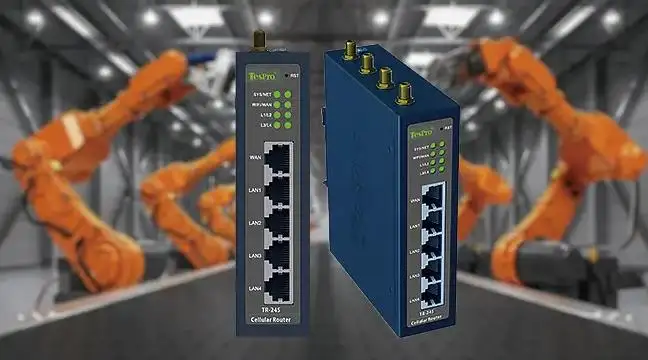
Tespro Fits the Shift Toward Managed Industrial Connectivity
The market is moving toward managed, visible, policy-driven connectivity rather than isolated edge hardware. Tespro appears to understand this shift.
Its website presents industrial routers not only as communication devices, but as part of a broader remote management and smart metering ecosystem. Tespro's cloud management messaging, along with its meter reading software platform, points to a more centralized operating model where devices, traffic, and field assets can be supervised at scale. That matches what many overseas buyers now want: fewer truck rolls, clearer asset visibility, and more control over lifecycle operations.
This direction also fits broader industry change. GSMA forecasts IoT connections reaching 38.7 billion by 2030, while Ericsson reports that broadband and critical IoT connections over 4G and 5G are expected to remain the largest share of cellular IoT through 2031. In simple terms, more industrial assets will depend on wide-area cellular networking, and those networks must be managed more intelligently.
Security and Remote Access Can No Longer Be Treated Lightly
Industrial buyers are also more cautious about remote access than they were a few years ago. As more field assets are connected to cloud platforms, the router becomes part of the cybersecurity posture.
Tespro's router materials reference VPN support and secure communication functions, which is important because secure remote access is now a board-level concern in many OT and utility environments. NIST's zero trust guidance has reinforced the move away from broad implicit trust toward controlled, policy-based access to assets and services. For industrial networking, that makes secure tunneling, segmentation logic, controlled access paths, and centralized administration more relevant than ever.
For procurement teams, the takeaway is straightforward: an industrial router should support not only uptime, but also controlled remote operations.
A stronger shortlist usually includes:
•VPN or encrypted remote access support
•Segmented access logic for devices and services
•Centralized monitoring and configuration
•Event visibility for troubleshooting
•Support for mixed interfaces such as LAN, RS485, and RS232
Tespro's industrial router positioning checks many of these boxes, particularly for projects that still combine serial equipment, Ethernet endpoints, and cloud-side data workflows.
Ready for Demanding Environments, Not Desk-Based Use
Tespro stays relevant because its design approach reflects the needs of real-world industrial installations. Industrial IoT often lives in cabinets, substations, roadside enclosures, workshops, and utility infrastructure where temperature swings, humidity, vibration, and unstable power conditions are real design constraints.
Tespro highlights wide-temperature range operation, wide-voltage input, DIN-rail-friendly installation, compact industrial design, and low-power operation. In this way, the solution reflects practical installation and operating requirements more than performance claims made under ideal test environments. Buyers evaluating industrial networking hardware usually care less about polished consumer-style specifications and more about whether the device will hold connection and remain serviceable in harsh conditions.
Why This Matters for Utilities, Campuses, and Smart Cities
The strongest use cases for this type of router are clear.
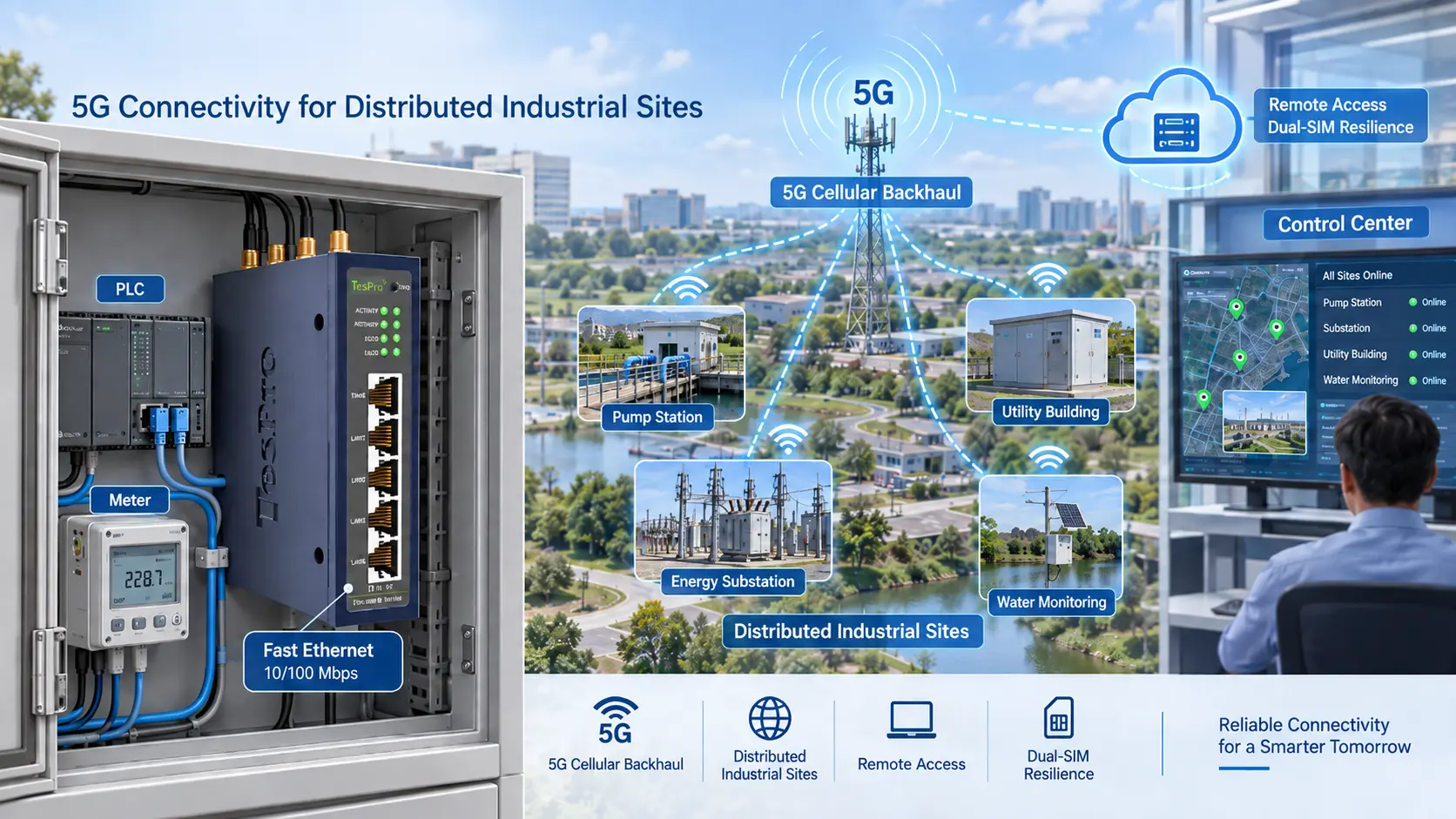
In the utilities sector, reliable edge communication enables remote meter reading, provides enhanced grid-side monitoring, and reduces reliance on manual data collection. Within campus environments, it facilitates the interconnection of distributed systems without the need for complex rewiring. In smart city deployments, it supports the continuous flow of operational data between field devices and control platforms.
Tespro's industrial routers are designed for these distributed, data-driven environments, where secure and continuous communication between field devices and the cloud has direct operational value. That makes Tespro relevant to current infrastructure trends, especially as more operators push for digitalization without accepting higher maintenance overhead.
Final Thought
For today's buyers, the best Industrial Cellular Router for IoT is not simply the one with the newest radio standard. It is the one that reduces field risk, supports secure remote operation, and keeps data moving when real-world conditions are less than ideal.
Tespro's strongest message is not just 4G or 5G availability. It is the combination of network redundancy, broad interface compatibility, remote management, and industrial-grade design. That combination fits where the market is heading: more connected assets, higher uptime expectations, tighter security requirements, and less tolerance for unmanaged edge infrastructure.
FAQ
1. What Is An Industrial Cellular Router For IoT?
An Industrial Cellular Router For IoT is a rugged networking device that connects field equipment, sensors, meters, controllers, and remote assets to cloud platforms or control centers through cellular networks. It is built for industrial environments and usually supports features such as wide voltage input, VPN, remote management, and multiple interfaces.
2. Why Is Network Redundancy Important In Industrial IoT?
Network redundancy helps maintain communication when one connection path becomes unstable or fails. In industrial settings, this can reduce downtime, protect data continuity, and support more stable operations at unattended or hard-to-reach sites.
3. How Does Dual SIM Improve Router Reliability?
Dual SIM allows the router to switch between carriers when signal quality drops or a carrier-side issue occurs. This gives users an extra layer of resilience, especially in remote locations where relying on one operator can create unnecessary risk.
4. Can An Industrial Cellular Router Work With Both Legacy And Modern Devices?
Yes. Many industrial cellular routers are designed to support mixed environments. They may offer Ethernet, RS232, and RS485 interfaces so users can connect older field devices alongside newer digital systems without rebuilding the whole site architecture.
5. What Industries Commonly Use Industrial Cellular Routers For IoT?
These routers are widely used in utilities, smart metering, industrial automation, smart buildings, oil and gas, transportation, environmental monitoring, campuses, and smart city infrastructure. They are especially useful where wired networking is difficult or costly.