


Industrial Cellular Router
Product ID: TR-324
Independently developed by Tespro, the TR-324 industrial router supports global 2G/3G/4G networks, Gigabit Ethernet (1*WAN + 2*LAN), and dual-band Wi-Fi 4/5. Built with 1*RS232, 2*RS485, and 4*GPIO interfaces plus Modbus/BACnet support, it ensures reliable connectivity for IoT and industrial automation.
-
Network
2G / 3G / 4G
-
Interface
1*WAN + 2*LAN 10 / 100 / 1000Mbps
-
Wi-Fi
Wi-Fi 4 (802.11b/g/n) / Wi-Fi 5 (802.11a/n/ac)
-
Serial & I/O
1*RS232 + 2*RS485 + 4*GPIO
Get Free Quote Now
Download
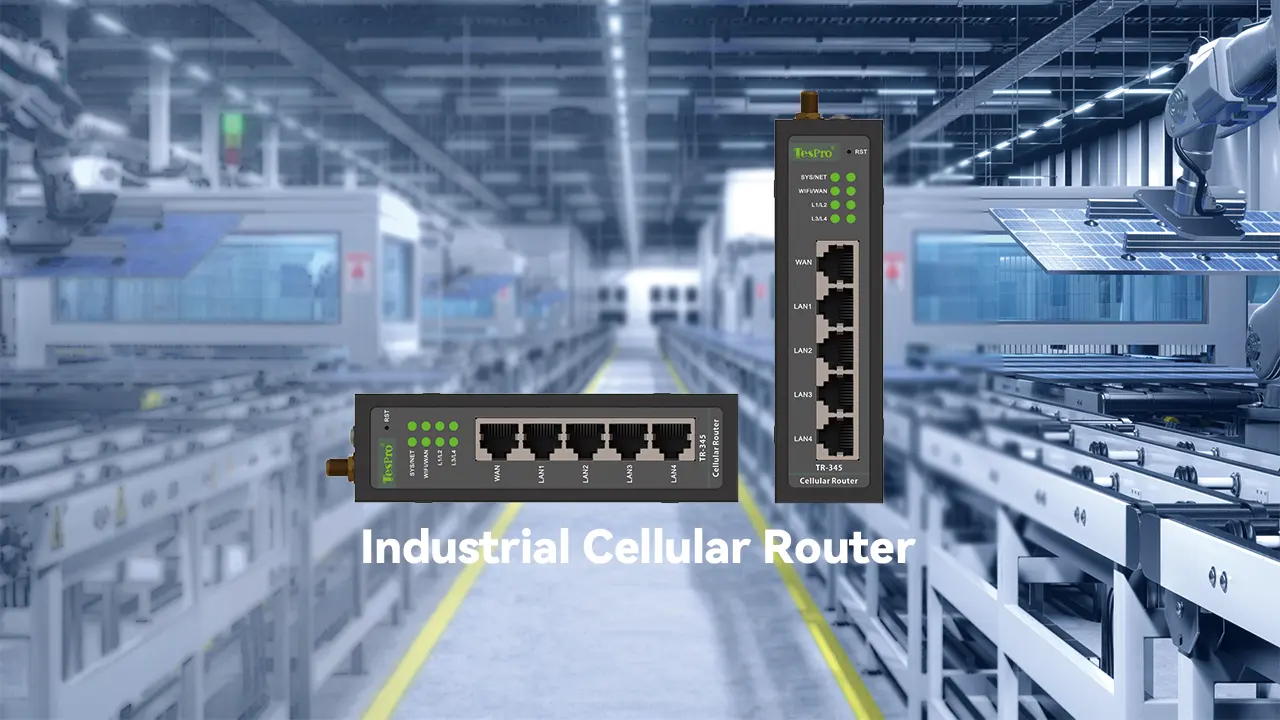
TR-324 Industrial Router Introduction
The video Industrial Router TR-324 illustrates the superior 4G LTE connectivity, toughness, and durability, safe remote access, and optimization of networking of automation, utilities, and smart IoT infrastructure.
Features
Core Advantages

4G/3G/2G & Dual SIM/eSIM
Supports extensive 2G/3G/4G cellular network access, with 4G LTE options including Cat1/Cat4/Cat6. Equipped with dual SIM and dual eSIM capabilities to enable flexible switching and link backup.

Gigabit Ethernet Interface & Wi-Fi
Equipped with Gigabit Ethernet ports supporting WAN/LAN auto-sensing, and featuring dual-band Wi-Fi 4 (2.4GHz) and Wi-Fi 5 (5GHz) capabilities, it combines high-speed wired transmission with convenient wireless access to meet the needs of industrial equipment connectivity, data transmission, and on-site networking.

Integrated Serial and GPIO Interfaces
An integrated design featuring serial ports (1*RS232 + 2*RS485) and 4*GPIO interfaces facilitates the connection of industrial equipment and enables control of digital (on/off) inputs and outputs.

TesproOS System & Remote O&M
Equipped with the proprietary TesproOS operating system and a visual web-based management dashboard, it enables full-lifecycle device management. It supports real-time cluster status monitoring, remote batch parameter configuration, log diagnostics, and cloud-based OTA firmware upgrades; combined with multi-layer VPN encryption, it facilitates efficient O&M without the need for on-site visits.

Rich Protocol Ecosystem
It integrates northbound cloud connectivity (MQTT/OPC UA), industrial fieldbuses (Modbus/ProfiNet), and industry-specific protocols for power and energy storage (DLT645/IEC61850). Combined with robust OpenVPN/IPSec encryption and rapid custom protocol development capabilities, it simplifies the device onboarding process—enabling plug-and-play functionality—and accelerates the convergence of OT and IT data.

Excellent Weather Resistance
Supporting a wide operating temperature range of -40°C to +75°C and non-condensing humidity levels of 5% to 95% RH, alongside an IP30 protection rating, it reliably handles complex and harsh industrial environments—including high altitudes, high temperatures, and high pressures—to ensure stable equipment operation.
Tech Specs
Industrial Router Specifications Table
Hardware Specifications
| Category | TR-324 |
| HardwareSystem | |
| CPU | Dual-core, four-thread processor with a base clock speed of 880 MHz |
| RAM | 128 MB, DDR3 |
| Flash | 32 MB |
| Network Interfaces | |
| Ethernet Ports | 3 x 10 / 100 / 1000 Mbps |
| Cellular Network | 4G LTE: Cat1 / Cat4 / Cat6 |
| WAN | 1 x WAN 10 / 100 / 1000Mbps |
| LAN | 2 x LAN 10 / 100 / 1000Mbps |
| SIM Slot | Dual SIM / Dual eSIM / 1× SIM + 1× eSIM |
| Antenna | SMA male (external thread, inner hole); Antenna Ports: 4 pcs |
| Physical Interfaces | |
| Grounding Terminal | 1 × Grounding Screw |
| Status Indicators | 6 pcs |
| Reset Button | 1 pc |
| Industrial Interfaces | |
| Serial Ports | 2 x RS485 + 1 x RS232, 3kV high-voltage isolation |
| I/O Interfaces | Supports 4 × I/O; DI/DO configurable |
| Wi-Fi Wireless Network / WLAN | |
| Wi-Fi Frequency | 2.4GHz, 5GHz |
| Protocol Standards | Wi-Fi 4: 802.11b/g/n; Wi-Fi 5: 802.11a/n/ac |
| Max. Transmission Rate | AC1200 |
| Data Rate | 802.11b/g/n: Up to 300Mbps; 802.11a/n/ac: Up to 867Mbps |
| Transmit Power | 802.11b: 16dBm ±2dBm (11Mbps); 802.11g: 16dBm ±2dBm (54Mbps); 802.11n@2.4GHz: 16dBm ±2dBm (HT20 MCS7); 802.11n@2.4GHz: 16dBm ±2dBm (HT40 MCS7) |
| Transmission Distance | Line-of-sight ≤ 100 meters (actual distance depends on the on-site environment) |
| Power Supply | |
| Power Interface | DC power interface: 1 (DC2.1) |
| Input Voltage Range | DC power supply: 12–36V; supports reverse polarity protection |
| PoE (Optional) | Supports PoE power supply; compatible with IEEE 802.3af / IEEE 802.3at (PoE+) standards |
| Standby Power | 120mA–200mA @12V |
| Operating Power | 150mA–320mA @12V |
| Peak Power | 320mA @12V |
| Environmental Conditions | |
| Operating Temperature | -40°C to +75°C |
| Operating Humidity | 5% to 95% (non-condensing) |
| Storage Temperature | -40°C to +80°C |
| Mechanical Specifications | |
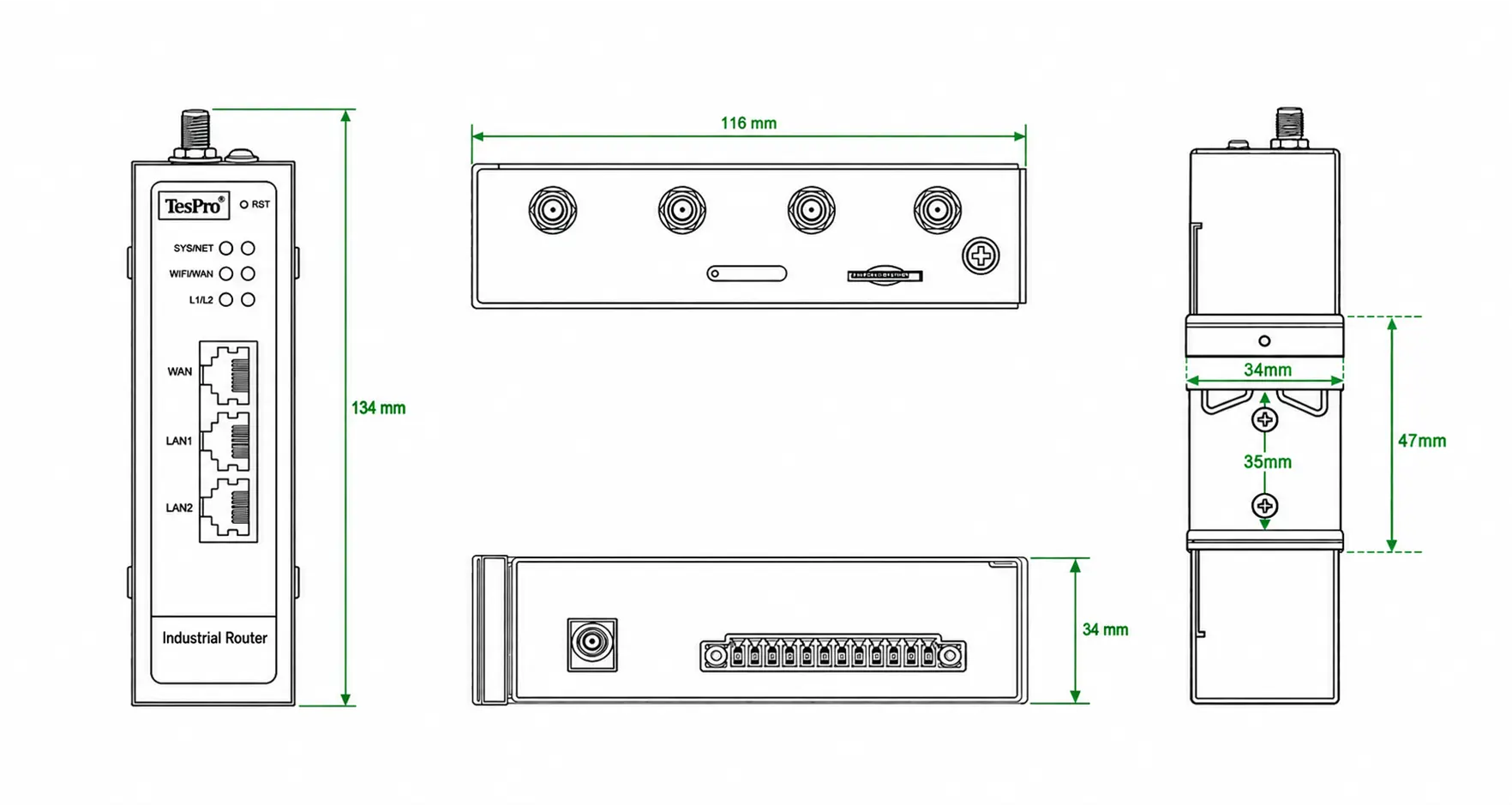
| Product Dimensions | 116 × 134 × 34 mm (including antenna connectors) |
| Protection Rating | IP30 |
| Housing | Metal housing |
| Mounting Method | DIN-rail / Wall-mount |
| Cooling Method | Fanless cooling |
| Product Weight | 450 g |
| Reliability | |
| Shock | IEC60068-2-27 |
| Vibration | IEC60068-2-6 |
| Drop | IEC60068-2-32 |
| Certifications and Standards | |
| Regulatory Certification | CE, RoHS |
| EMC Standards | EN 55032; EN 55035; EN IEC 61000-6-3:2021; EN IEC 61000-6-1:2019; EN 301489-1; EN 301489-17; EN 301 489-52 |
| RF Standards | EN300328; EN301893; EN301511; EN301908-1/-2/-13 |
| SAR+Safety | EN50665; EN IEC62368-1 |
| Cyber | EN18031-1; EN18031-2 |
| ESD (Electrostatic Discharge) | EN 61000-4-2:2009 |
| Radiated Immunity | EN IEC 61000-4-3:2020 |
| Burst (EFT) | EN 61000-4-4:2012 |
| Surge | EN 61000-4-5:2014 + A1:2017 (Ethernet ports) |
| Conducted Immunity | EN 61000-4-6:2014 |
| Oscillatory Waves Immunity | EN61000-4-12, level 3 |
| Magnetic Field Immunity | EN61000-4-8, Horizontal/Vertical 400A/m (>level 2) |
Software Specifications
| Category | TR-324 |
| Industrial Protocols and Data Capabilities | |
| Industrial Protocols | Includes Modbus RTU, Modbus TCP, BACnet, Mbus, OPC UA, and various other protocols |
| Modbus | Modbus RTU, Modbus TCP |
| Industrial Device Protocols | ProfiNet, EtherCat, EtherNet (optional) |
| BACnet | BACnet |
| OPC UA | OPC UA |
| Electricity Meter Protocols | DLT 645-2007, IEC 1107, IEC 61850, IEC 62056-21, DLMS |
| DN3 | Supported modes: Station, Outstation; Connection: TCP |
| DLMS/COSEM | DLMS |
| Modbus Custom Registers | Modbus TCP custom register module requests, capable of reading/writing files within the router, extending Modbus TCP client functionality |
| Supported Data Formats | INT/UINT (8/16/32-bit), 32-bit Float, HEX, ASCII; supports MSB/LSB and byte order conversion (ABCD/DCBA/CDAB/BADC) |
| DTU Function | Supports TCP/UDP transparent transmission; supports Modbus RTU to Modbus TCP conversion; supports DCTCP/DCUDP modes |
| Data to Server | HTTP(S)/MQTT/Azure MQTT; multi-source data reporting; min 1s interval; Lua scripting |
| Modbus / MQTT Gateway | Allows sending commands to a Modbus Server via an MQTT Broker and receiving data |
| API / Web API | Supports network Web API; API endpoints for retrieving or changing data |
| Networking Capabilities | |
| Network Access | 2G/3G/4G cellular network (or VPDN private network) |
| Access Authentication | Supports CHAP/PAP authentication |
| LAN Protocols | ARP, Ethernet |
| WAN Protocols | PPP, PPPoE, DHCP; TCP, UDP, IPv4, IPv6, ICMP, NTP, DNS, HTTP, HTTPS, SFTP, FTP, SMTP, SSL/TLS, ARP, VRRP, PPP, PPPoE |
| Network Protocols | UPnP, SSH, DHCP, Telnet, SMPP, SNMP, MQTT |
| Routing | Static routing, OSPF dynamic routing |
| NAT | DMZ, NAT, NAT-T, NAT64 (listed under Firewall) |
| DHCP | Static and dynamic IP allocation, DHCP relay, DHCP server configuration, status, static leases; supports wildcard MAC addresses |
| Network Backup / Failover | Wi-Fi WAN, VRRP, and wired connection options; all can be used as automatic failover solutions |
| QoS | Traffic priority queuing based on source/destination, service, protocol, or port; WMM, 802.11 |
| IP Applications | Supports Ping, Traceroute, DHCP Server, DHCP Relay, DHCP Client, DNS relay, DDNS, Telnet |
| DNS/DDNS | Supports DoH (DNS over HTTPS); multiple DDNS service provider configurations and manual customizatio |
| Wi‑Fi | |
| Wireless Modes | Wi‑Fi 4: 802.11b/g/n; Wi‑Fi 5: 802.11a/n/ac; supports Access Point (AP) and Station (STA) modes |
| Wi‑Fi Security | WPA2‑Enterprise/PSK, WPA‑EAP/PSK, WPA3‑SAE/EAP, OWE; AES‑CCMP, TKIP, client separation, EAP‑TLS, 802.11w PMF, etc |
| Maximum Wi‑Fi Clients | Wi‑Fi 4: up to 30 simultaneous connections; Wi‑Fi 5: up to 50 simultaneous connections |
| Hotspot Relay | Forwards the Wi‑Fi hotspot login page to subsequent connected devices (captive portal relay) |
| SSID / ESSID | SSID stealth mode; MAC‑address‑based access control |
| Operating Modes | Supports AP, Client, and WDS (Wireless Distribution System) modes |
| Security Features | Open system, Shared key, WPA/WPA2 authentication; WEP/TKIP/AES encryption |
| Network Security & VPN | |
| Network Protection Security | Port forwarding / traffic rules / custom TTL; WebUI/CLI firewall configuration; DMZ, NAT/NAT‑T/NAT64 |
| Data Protection Security | Supports VPN functions including PPTP, L2TP, GRE, IPSEC VPN, DMVPN, OPENVPN, WireGuard, etc.; supports digital certificate CA |
| Authentication | Pre-shared keys, X.509 certs, TACACS+, RADIUS (built-in/external), IP/time/login blocking, random password generator |
| Attack Protection | DDoS protection (SYN flood, SSH, HTTP/HTTPS); Port scanning protection (SYN-FIN, SYN-RST, X-mas, NULL, FIN) |
| VLAN | Port‑based and Tag‑based VLAN isolation |
| Access Control | Flexible access control for SSH, Web UI, CLI, and Telnet |
| Web Filter | Blacklist for unwanted websites; whitelist for allowed websites only |
| Certificate Management | Certificate generation tools; can create CA, server, client, Let's Encrypt, and SCEP certificates |
| OpenVPN | Supports multiple clients and one server simultaneously; supports 27 encryption methods |
| IPsec | XFRM, IKEv1, IKEv2; 14 encryption methods for IPsec: 3DES, DES, AES128, AES192, AES256, AES128/192/256 GCM8/12/16 |
| WireGuard | Supports WireGuard VPN client and server |
| GRE | Supports GRE tunnels, GRE over IPsec tunnels |
| PPTP / L2TP | Client and server instances can run simultaneously; supports L2TPv3, L2TP over IPsec |
| DMVPN | Scalable IPsec VPN; supports Phase 2, Phase 3, and Dual Hub |
| SSTP | Supports SSTP client instance |
| ZeroTier | Supports ZeroTier VPN client |
| Stunnel | Adds TLS encryption to existing clients and servers via proxy |
| Tinc | Encryption, authentication, and compression within tunnels; supports client and server modes |
| EoIP | Ethernet over IP tunnel based on GRE RFC 1701 |
| Management & Platform | |
| Configuration Methods | Web UI, CLI, SSH, JSON‑RPC, TesproOS, etc |
| Cloud & IoT Platform | Supports Google, Huawei, Amazon, Microsoft Azure, iStarOS, Azure IoT Hub, other third-party cloud platforms, and custom clouds |
| FOTA | Firmware updates from server with automatic notification |
| SNMP | SNMP (v1, v2, v3), SNMP Trap |
| MQTT | MQTT Broker, MQTT Publisher |
| JSON‑RPC | HTTP/HTTPS‑based management API |
| SSH | SSH (v1, v2) |
| Upgrade Methods | FOTA; Web UI |
| Logging Functions | Event log, system log, kernel log |
| Alert Functions | Email message status alerts |
| On-Demand Activation | On‑demand dialing, data activation, SMS activation |
| Receives email message status alerts from various services | |
| Software System | |
| Operating System | TesproOS (Linux) |
| Supported Languages | Busybox shell, Lua, C, C++, Python |
| Development Tools | SDK package including build environment |
| Firmware Customization | Supports custom branded firmware and web page applications (colours, logos, etc.) |
| Package Management | Supports installation of additional software packages |
| Firmware & Configuration | |
| Web UI Upgrade | Update firmware from file, check for firmware on server, configuration file, configuration backup |
| FOTA Upgrade | Update firmware |
| Cloud Bulk Upgrade | Supports updating firmware/configurations of multiple devices at once via TesproOS system |
| Config-Preserved Upgrade | Update firmware without losing current configuration |
| Factory Reset | Full factory reset, restoring all system settings including IP address, PIN code, and user data |
| Environment & Reliability | |
| Hot Backup / VRRP | VRRP (listed under Network Backup) |
| Link Online Detection | Sends heartbeat packets for detection; automatically reconnects upon disconnection |
| Dual SIM Link Switching | Supports dual SIM or dual eSIM link switching |
| Built‑in Watchdog | Device self‑check technology; automatic self‑recovery from runtime faults |

Show All

Show Less
Product Details
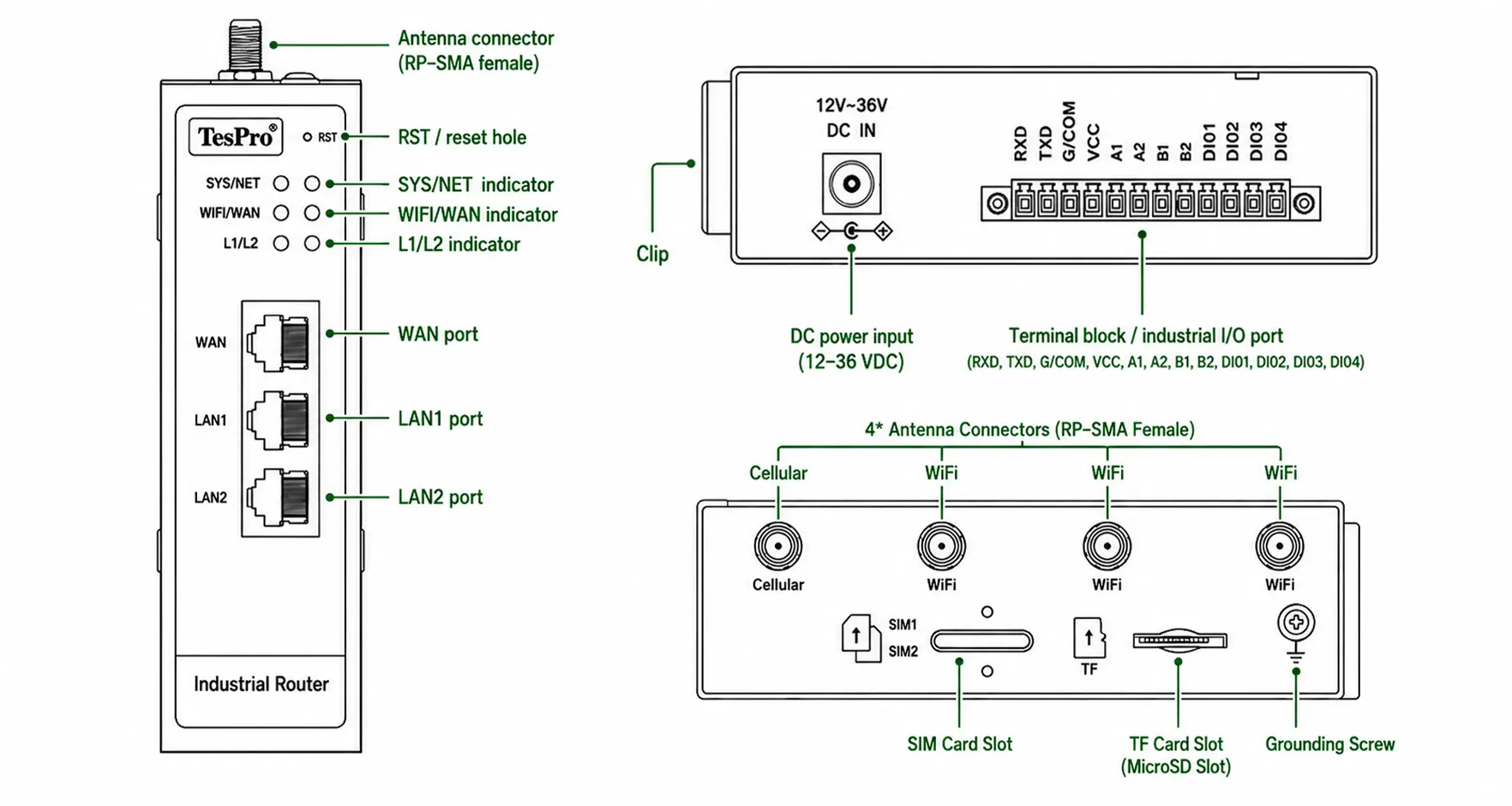
Interface Diagram
Dimensions Diagram
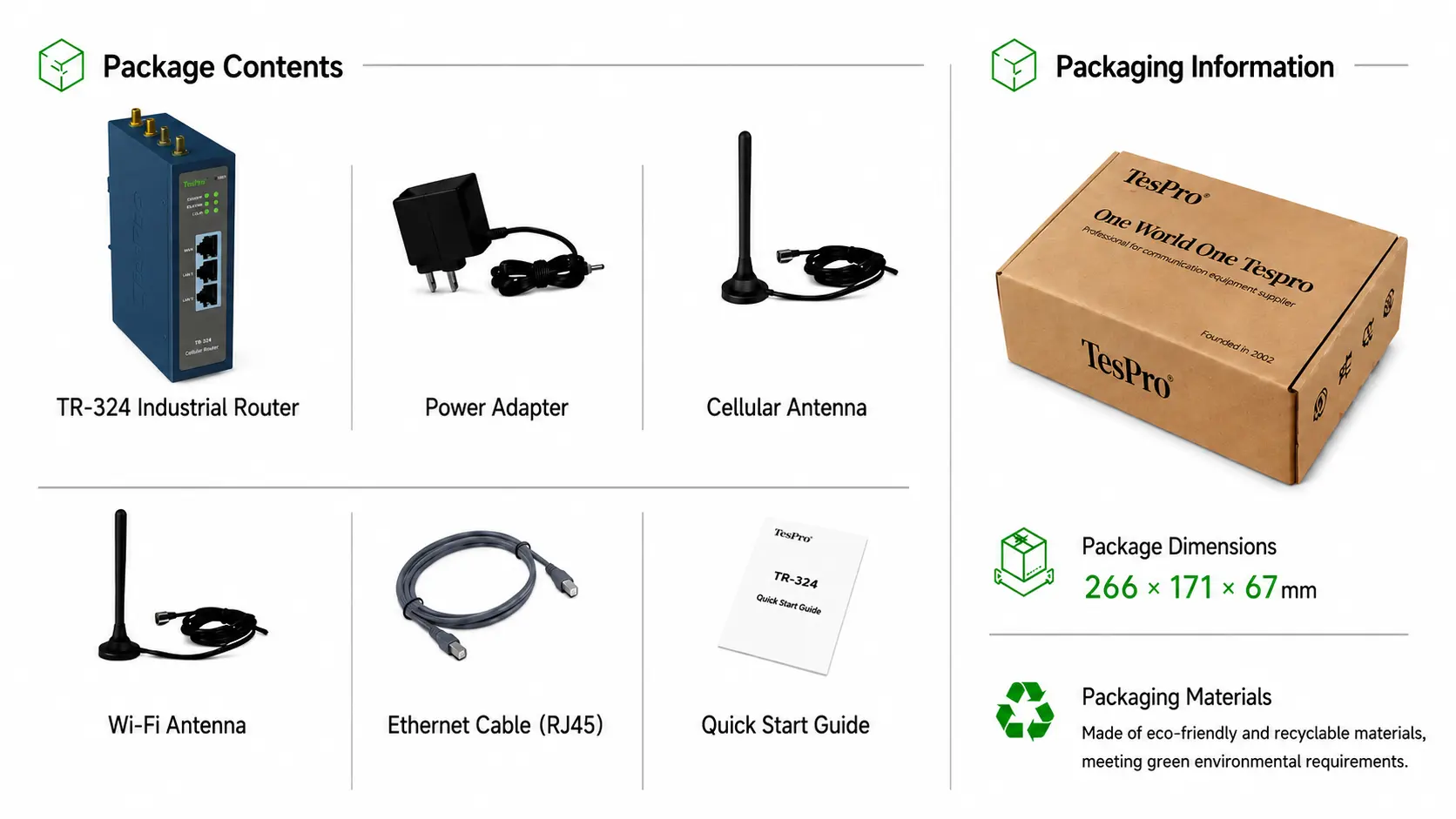
Accessories Diagram
Explore our Solutions
Industrial Connectivity & Networking Solutions
Delivering robust cellular and Ethernet networking solutions engineered for reliable data transmission in diverse industrial scenarios


Case
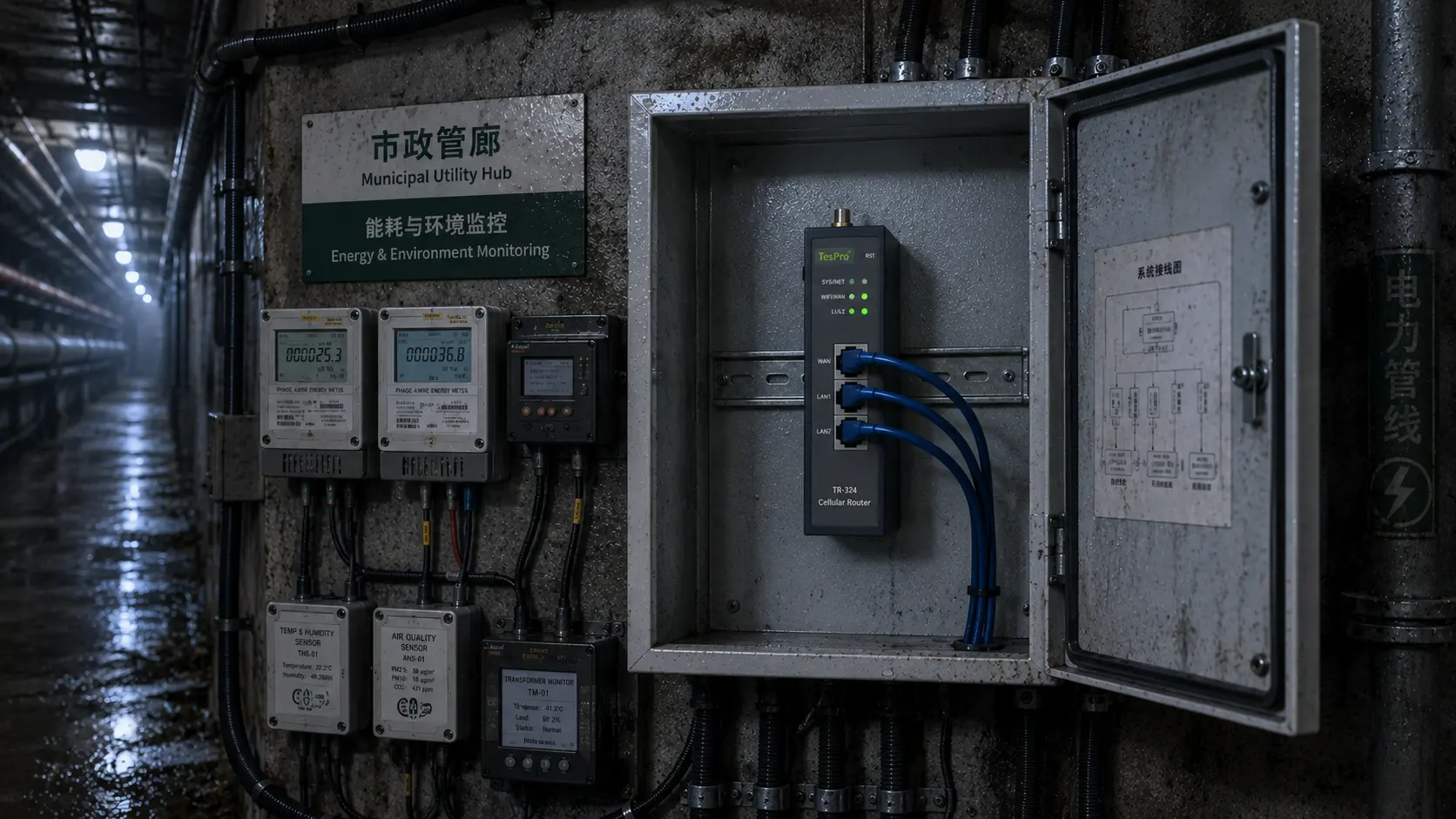
Case 1: Municipal Utility & Underground Pipe Gallery
Challenge
High humidity and severe dust in underground utility rooms led to frequent hardware failures. Mixed legacy RS485 meters and modern Ethernet controllers required a high-density, multi-interface gateway with stable wireless backhaul.
Solution & Value
IP30 Rugged Design: Withstands extreme moisture and dust, ensuring 24/7 continuous operation in harsh environments.
Versatile Connectivity: Integrated 3× Ethernet, 1× RS232, and 2× RS485 interfaces seamlessly connect legacy smart meters and modern edge controllers.
Zero-Downtime Networking: Dual 4G SIM card backup and auto-failover prevent data loss during peak network traffic times.
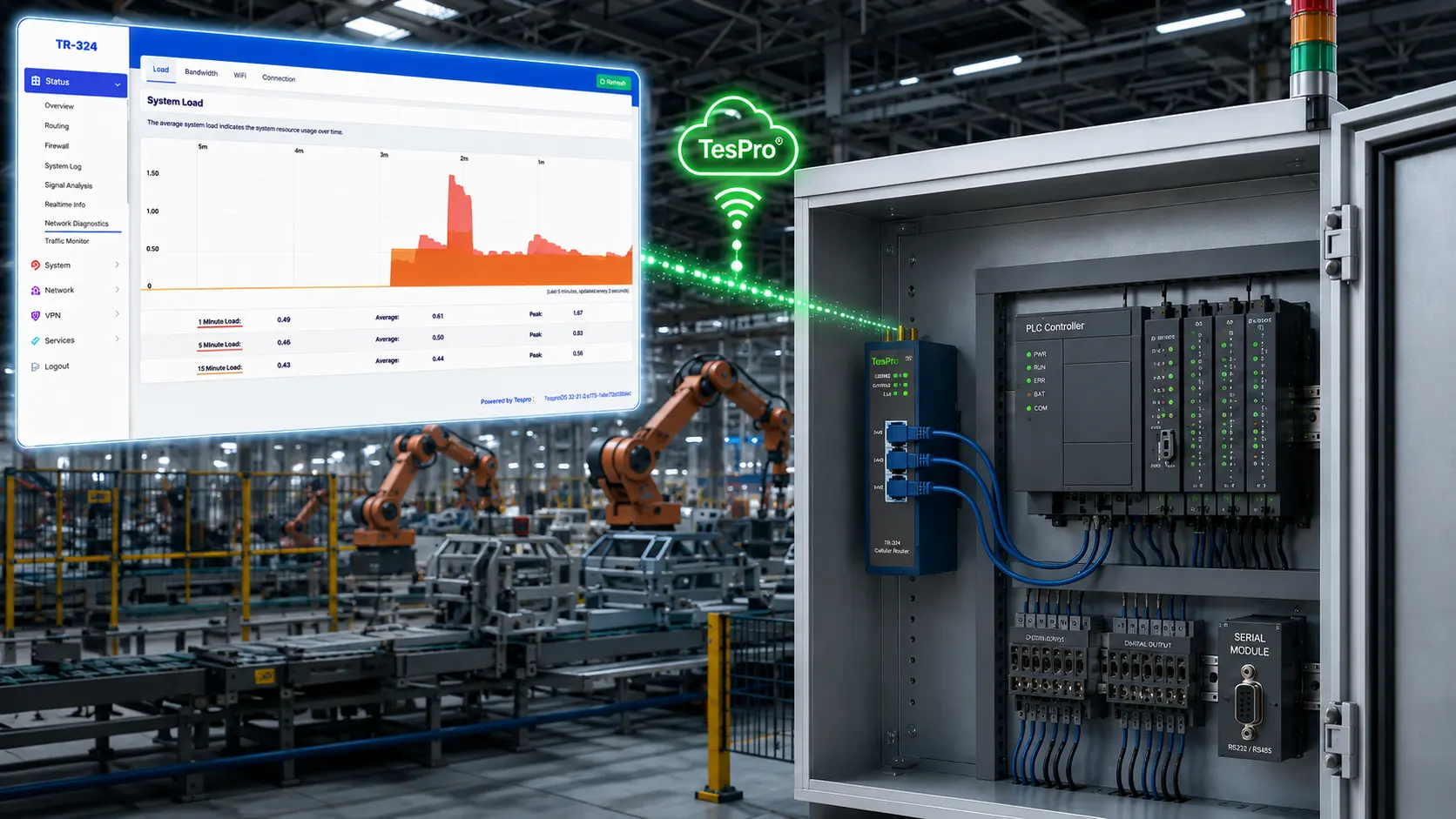
Case 2: Smart Factory & Remote PLC Diagnostics
Challenge
High electromagnetic interference (EMI) on factory floors disrupts ordinary routers. Dispersed production lines make field maintenance costly and time-consuming when PLC troubleshooting is required.
Solution & Value
Industrial EMI Protection: Delivers robust interference resistance for stable data passthrough in noisy automation environments.
Encrypted Remote Diagnostics: Establishes secure VPN tunnels allowing engineers to perform online PLC program updates and fault analysis without traveling onsite.
High-Speed Transmission: Dual-band Wi-Fi 4、Wi-Fi 5 and Gigabit Ethernet handle high-bandwidth needs like industrial vision inspection systems.
Download Materials


Frequently Asked Questions
To help you better understand our products' performance, compatibility, and usage, we’ve compiled answers to commonly asked questions. If your inquiry isn’t listed below, feel free to contact us directly for further assistance.
Contact Us
-
What network and communication methods do TR300-Class industrial routers support?

-
The core value of this series is connecting field devices to carrier cellular networks while providing local Ethernet and Wi-Fi connectivity. Using representative models from the official website as examples, TR-324 corresponds to 4G LTE and TR-325 to 5G LTE; the product-series catalog also covers different cellular generations. For multinational projects, support for local 2G/3G fallback, specific LTE/5G bands, carrier certification, and APN configuration should be confirmed in writing by sales according to the target country and module version.
1. Cellular network: TR-324 is designed for 4G LTE, while TR-325 is designed for 5G LTE. If a project requires multi-mode fallback or specific frequency bands, the target region, carrier, and module configuration must be verified.
2. Wi-Fi: The representative model pages list IEEE 802.11 a/b/g/n/ac and cover the 2.4 GHz and 5 GHz bands. Dual-band Wi-Fi can be used for nearby maintenance, local terminal access, or as a backup link; actual throughput varies with the chipset, channel bandwidth, environment, and model.
3. Wired Ethernet: Gigabit LAN is suitable for connecting PLCs, industrial switches, cameras, HMIs, edge devices, or local maintenance PCs to the same network.
4. Redundancy concept: Representative model pages mention dual-SIM standby and backup switching among wired, Wi-Fi, and cellular links. Dual SIM does not mean every model supports eSIM or automatic dual-carrier strategies; projects must confirm the SIM slots, switching policy, and service plan.
-
What interfaces do TR300-Class industrial routers provide, and how are field devices connected?
-
Representative models typically combine “cellular uplink + Gigabit Ethernet + industrial serial ports.” For devices such as energy meters, PLCs, variable-frequency drives, and environmental sensors, Ethernet, RS485, or RS232 can be selected according to the device interface. Routers are better suited to providing connectivity, forwarding, remote maintenance, and local network management; complex protocol acquisition/conversion requirements can be addressed together with an industrial gateway or protocol converter.
1. Ethernet ports: The top sections of the TR-324/325 pages both list a 2×LAN Gigabit configuration; the specification sections also contain descriptions of LAN0 supporting WAN/LAN auto-adaptation and three Gigabit LAN ports. The inquiry should therefore clearly specify “WAN/LAN quantity, Gigabit/100 Mbps, and whether switching is supported.”
2. Serial ports: The pages confirm RS485- and RS232-type interfaces for common industrial field devices. The exact port quantities are not presented consistently, so the BOM should explicitly lock down the number of RS485/RS232 ports, terminal definitions, isolation requirements, and termination-resistor requirements.
3. SIM and antennas: Representative model pages list dual-layer SIM slots and SMA antenna connectors. The quantity and gain of cellular and Wi-Fi antennas should be confirmed together with site coverage, cabinet installation, and lightning-protection requirements.
4. Power and installation: Representative models are rated for DC 12–36 V and include DC power input, reset, and status indication. The product introduction also describes DIN-rail mounting for deployment inside control cabinets.
-
What are the key technical advantages of TR300-Class industrial routers?
-
The advantage of TR300-Class routers is not simply “Internet access,” but the combination of cellular WAN connectivity, field-device access, network redundancy, and industrial environmental adaptability in an engineering-ready connection node. The following six points are suitable for websites, proposals, or customer inquiry responses, but the product-selection note “confirm by model” should be retained.
1. Multi-mode cellular access: 4G or 5G models meet different bandwidth and latency requirements, while dual-SIM and multi-network redundancy can be confirmed on a project basis.
2. Gigabit local networking: Representative models provide Gigabit Ethernet for industrial switches, edge terminals, and local maintenance networks.
3. Industrial serial connectivity: RS485/RS232 helps connect legacy PLCs, meters, controllers, and smart meters, reducing the need for additional interface converters.
4. Remote network operation and maintenance: The router section of the official website mentions VPN support and remote management. The VPN types actually available, account permissions, remote upgrade functions, and platform capabilities must be confirmed according to the software version, project architecture, and security policy.
5. Link-continuity design: Representative pages mention dual-SIM standby and backup switching among cellular, Wi-Fi, and wired links to reduce the impact of a single unavailable network on data backhaul.
6. Adaptability to harsh environments: The TR-324/325 pages list operation from -40°C to +75°C, 5%–95% non-condensing humidity, and wide-voltage DC 12–36 V, making them suitable for industrial cabinets, protected outdoor enclosures, and utility facilities. For high-altitude, high-humidity, high-salt-fog, or high-voltage environments, product certification and enclosure-system design must be confirmed separately.
-
What are the main application scenarios for TR300-Class industrial routers?
-
This series is particularly suitable for projects where “devices are distributed, on-site service is costly, and stable wide-area network backhaul is required.” The following six categories are typical directions; actual solutions should first complete signal testing, network-security design, power-supply evaluation, and protocol integration testing.
1. Industrial automation: Connect PLCs, HMIs, variable-frequency drives, or production-line control networks to enable status viewing, remote maintenance, and cross-site data backhaul.
2. Smart buildings: Connect building controllers, energy meters, HVAC plant rooms, or BMS subnets to upper-level platforms.
3. Outdoor environmental monitoring: Provide cellular backhaul for weather, dust, water-quality, and station sensors; waterproof enclosures, surge protection, and antenna solutions are also required.
4. Intelligent transportation: Used for distributed network nodes such as roadside equipment, parking systems, bus stops, and traffic monitoring.
5. Smart energy and power: Connect electricity meters, distribution monitoring devices, PV inverters, or energy-storage subsystems and transmit data to a central platform.
6. Smart robots and mobile equipment: Provide cellular network access for mobile or remote equipment in warehouses, campuses, construction machinery, and similar scenarios; bandwidth, roaming, coverage, and security policies must be validated on site.
-
Which protocols and systems are TR300-Class industrial routers suitable for?
-
Representative model pages list multiple power-metering and industrial protocols, including DL/T 645-2007, IEC 62056-21, IEC 1107, IEC 61850, DLMS, as well as Modbus RTU, Modbus TCP, BACnet, M-Bus, and OPC UA. Note that the router’s fundamental role is network transmission and remote connectivity. Whether it can “directly parse, acquire, or convert” a specific protocol also depends on the purchased model’s software functions, the peer device, mapping rules, and the project integration method.
1. When an existing host computer, edge gateway, or platform performs protocol parsing, the router can provide stable cellular backhaul and local network access.
2. When multi-device acquisition, offline caching, edge logic, and large-scale protocol adaptation are required, prioritize evaluation of the TG series industrial gateways.
3. When explicit data mapping between BACnet and Modbus, or OPC UA and Modbus, is required, prioritize evaluation of the TC-100 protocol converter.
4. Before purchasing, provide the device protocol manual, point list, baud rate/parity settings, network topology, security requirements, and target-platform interface so that feasibility can be confirmed.
-
How are warranty, pricing, and purchasing handled for TR300-Class industrial routers?
-
The official product pages provide “Request a Quote” and sales contact options, but do not publish a uniform standard warranty period, retail prices for all SKUs, or extended-warranty terms. Therefore, external publications should state that details are “subject to the written sales quotation, order, and contract,” and should avoid presenting an unpublished one-year warranty or 2–5-year extended warranty as an established commitment.
1. Warranty and extended warranty: It is recommended to provide sales with the model, quantity, deployment country, project environment, service-response requirements, and spare-parts requirements, and request written quotations for the standard warranty, 2–5-year extended warranty, or project services.
2. Pricing and samples: Small-quantity samples can be viewed through the Tespro Online Shop; bulk purchases, OEM/ODM, specific frequency bands, custom protocols, or project packages should be formally quoted by sales.
3. Contact sales: The sales quotation email is sales@tespro.com; the general inquiry email is info@tespro.com. The official website lists telephone/WhatsApp numbers +852 4609 4648 and +1-213 610 4797.
4. Learn more: Products, cases, and demonstrations can be viewed through Tespro’s official Facebook, LinkedIn, YouTube, TikTok, X, and Instagram accounts. The official datasheet and written response should be treated as the final technical reference.
5. Inquiry recommendation: Including the model, country/carrier, quantity, network bands, SIM plan, interfaces, protocols, temperature/humidity and enclosure requirements, lightning protection, certification, lead time, and after-sales requirements in the email can significantly improve product-selection and quotation efficiency.