-1791966549842.webp)





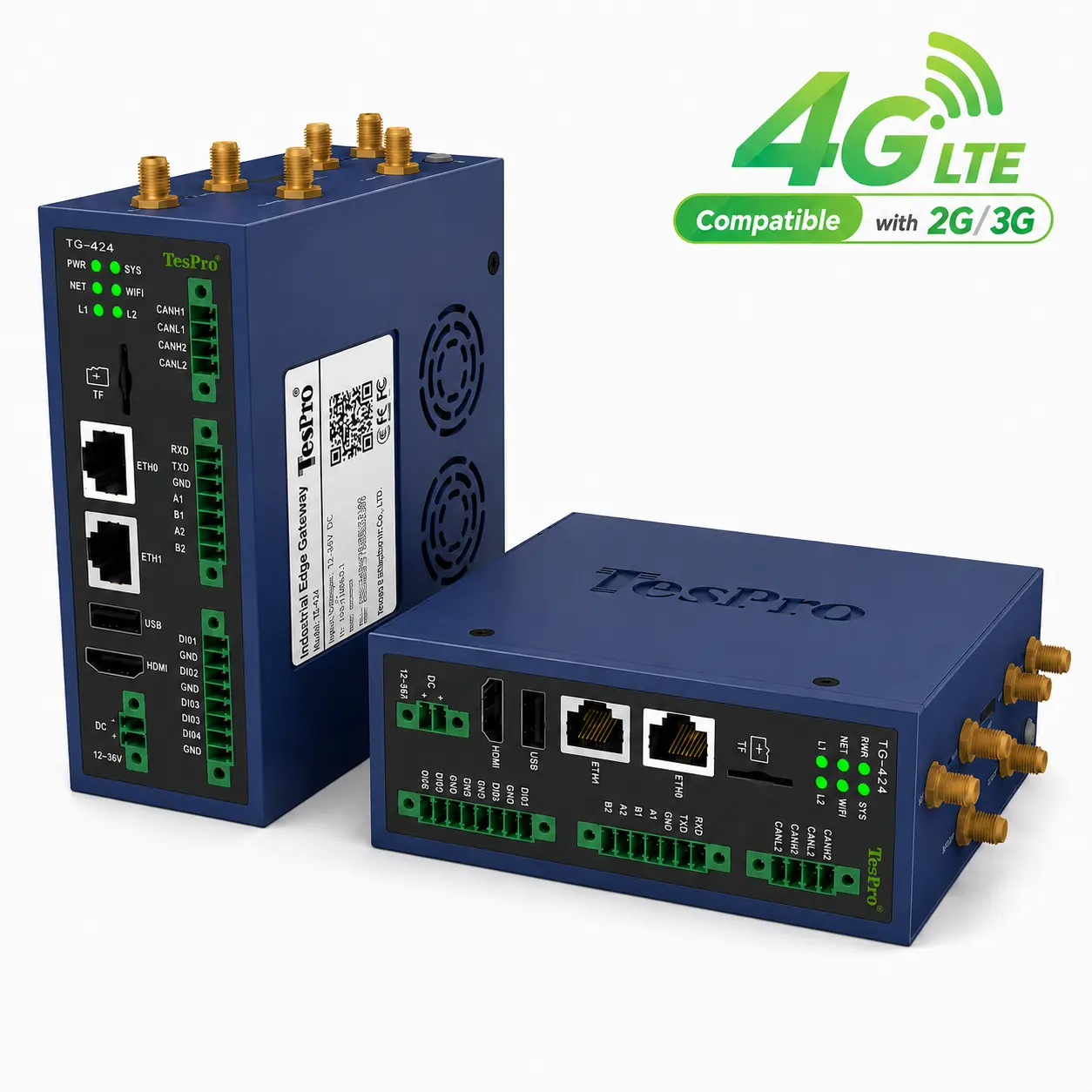


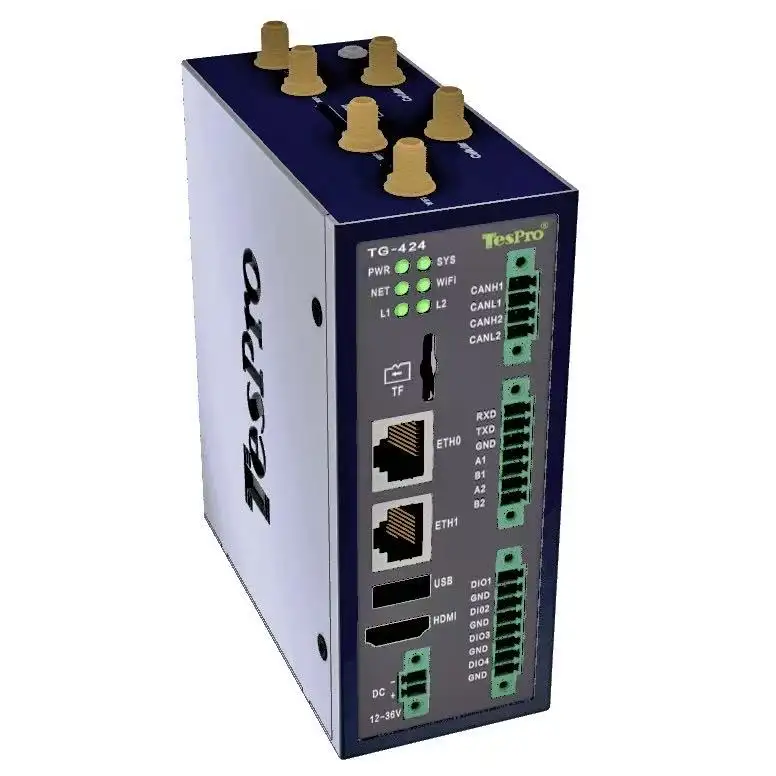


Industrial Gateway
Product ID: TG-424
Independently developed by Tespro, TG-424 is a high-performance industrial router supporting global 2G/3G/4G networks, Gigabit Ethernet (1×WAN + 1×LAN), and dual-band Wi-Fi 4(2.4GHz) / Wi-Fi 6 (2.4GHz & 5GHz). Equipped with 1×RS232 + 2×RS485, and 4×GPIO interfaces, alongside built-in Modbus and BACnet protocol conversion, it provides versatile data acquisition, edge computing, and secure cloud connectivity for industrial automation and IoT applications.
-
Network
2G / 3G / 4G
-
Interface
1*WAN + 1*LAN 10 / 100 / 1000Mbps
-
Wi-Fi
Wi-Fi 4 (802.11b/g/n) / Wi-Fi 6 (802.11a/b/g/n/ac/ax)
-
Serial & I/O
1*RS232 + 2*RS485 + 4*GPIO
Get Free Quote Now
Datasheet Download
Features
Core Advantages

4G/3G/2G & Dual SIM/eSIM
Supports extensive 2G/3G/4G cellular network access, with 4G LTE options including Cat1/Cat4/Cat6. Equipped with dual SIM and dual eSIM capabilities to enable flexible switching and link backup.

Gigabit Ethernet Interface & Wi-Fi
Equipped with Gigabit Ethernet ports supporting WAN/LAN auto-sensing, and featuring dual-band Wi-Fi 4 (2.4GHz) and Wi-Fi 6 (2.4GHz & 5GHz) capabilities, it combines high-speed wired transmission with convenient wireless access to meet the needs of industrial equipment connectivity, data transmission, and on-site networking.

Integrated Serial and GPIO Interfaces
An integrated design featuring serial ports (1*RS232 + 2*RS485) and 4*GPIO interfaces facilitates the connection of industrial equipment and enables control of digital (on/off) inputs and outputs.

TesproOS System & Remote O&M
Equipped with the proprietary TesproOS operating system and a visual web-based management dashboard, it enables full-lifecycle device management. It supports real-time cluster status monitoring, remote batch parameter configuration, log diagnostics, and cloud-based OTA firmware upgrades; combined with multi-layer VPN encryption, it facilitates efficient O&M without the need for on-site visits.

Rich Protocol Ecosystem
It integrates northbound cloud connectivity (MQTT/OPC UA), industrial fieldbuses (Modbus/ProfiNet), and industry-specific protocols for power and energy storage (DLT645/IEC61850). Combined with robust OpenVPN/IPSec encryption and rapid custom protocol development capabilities, it simplifies the device onboarding process—enabling plug-and-play functionality—and accelerates the convergence of OT and IT data.

Excellent Weather Resistance
Supporting a wide operating temperature range of -40°C to +75°C and non-condensing humidity levels of 5% to 95% RH, alongside an IP30 protection rating, it reliably handles complex and harsh industrial environments—including high altitudes, high temperatures, and high pressures—to ensure stable equipment operation.
Tech Specs
Industrial Gateway Specifications Table
Hardware Specifications
| Category | TG-424 |
| HardwareSystem | |
| CPU | Dual-core Cortex-A53 processor, 1.3GHz clock speed |
| RAM | 4GB LPDDR4X / 8GB LPDDR4X,8GB is standard |
| Flash | 8G / 16G / 32GB / 64GB eMMC,32GB is standard |
| Network Interfaces | |
| Ethernet Ports | 2 x 10 / 100 / 1000Mbps |
| Cellular Network | 4G LTE: Cat1 / Cat4 / Cat6 |
| WAN | 1 x WAN 10 / 100 / 1000Mbps |
| LAN | 1 x LAN 10 / 100 / 1000Mbps |
| SIM Slot | Dual SIM / Dual eSIM / 1× SIM + 1× eSIM |
| Antenna | SMA male (external thread, inner hole); Antenna Ports: 6 pcs |
| Physical Interfaces | |
| Grounding Terminal | 1 × Grounding Screw |
| Status Indicators | 6 pcs |
| Reset Button | 1 pc |
| Industrial Interfaces | |
| Serial Ports | 2 x RS485 + 1 x RS232, 3kV high-voltage isolation |
| I/O Interfaces | Supports 4 × I/O; DI/DO configurable |
| Wi-Fi Wireless Network / WLAN | |
| Wi-Fi Frequency | 2.4GHz, 5GHz |
| Protocol Standards | Wi-Fi 4: 802.11b/g/n; Wi-Fi 6: 802.11a/b/g/n/ac/ax |
| Max. Transmission Rate | AX3000 |
| Data Rate | 802.11b/g/n: up to 574Mbps; 802.11a/b/g/n/ac/ax: up to 2402Mbps |
| Transmit Power | 802.11b: 16dBm ±2dBm (11Mbps); 802.11g: 16dBm ±2dBm (54Mbps); 802.11n@2.4GHz: 16dBm ±2dBm (HT20 MCS7); 802.11n@2.4GHz: 16dBm ±2dBm (HT40 MCS7) |
| Transmission Distance | Line-of-sight ≤ 100 meters (actual distance depends on the on-site environment) |
| Power Supply | |
| Power Interface | DC power interface: 1 (DC2.1) |
| Input Voltage Range | DC power supply: 12–36V; supports reverse polarity protection |
| PoE (Optional) | Supports PoE power supply; compatible with IEEE 802.3af / IEEE 802.3at (PoE+) standards |
| Standby Power | 5W |
| Operating Power | 6-10W |
| Peak Power | 20W |
| Environmental Conditions | |
| Operating Temperature | -40°C to +75°C |
| Operating Humidity | 5% to 95% (non-condensing) |
| Storage Temperature | -40°C to +80°C |
| Mechanical Specifications | |
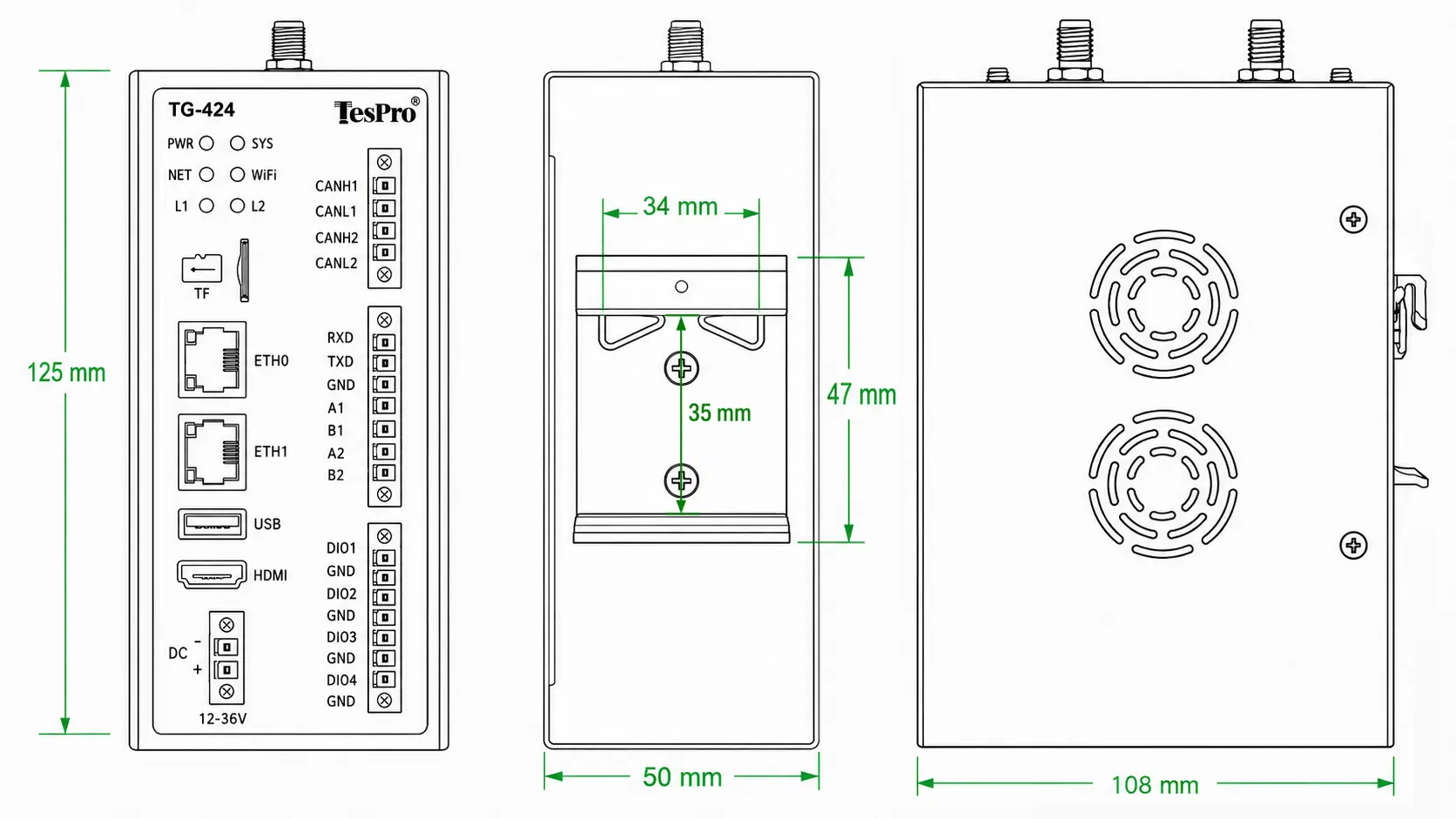
| Product Dimensions | 125 × 108 × 50 mm (including antenna connectors) |
| Protection Rating | IP30 |
| Housing | Metal housing |
| Mounting Method | DIN-rail / Wall-mount |
| Cooling Method | Fanless cooling |
| Product Weight | 550 g |
| Reliability | |
| Shock | IEC60068-2-27 |
| Vibration | IEC60068-2-6 |
| Drop | IEC60068-2-32 |
| Certifications and Standards | |
| Regulatory Certification | CE, RoHS |
| EMC Standards | EN 55032; EN 55035; EN IEC 61000-6-3:2021; EN IEC 61000-6-1:2019; EN 301489-1; EN 301489-17; EN 301 489-52 |
| RF Standards | EN300328; EN301893; EN301511; EN301908-1/-2/-13 |
| SAR+Safety | EN50665; EN IEC62368-1 |
| Cyber | EN18031-1; EN18031-2 |
| ESD (Electrostatic Discharge) | EN 61000-4-2:2009 |
| Radiated Immunity | EN IEC 61000-4-3:2020 |
| Burst (EFT) | EN 61000-4-4:2012 |
| Surge | EN 61000-4-5:2014 + A1:2017 (Ethernet ports) |
| Conducted Immunity | EN 61000-4-6:2014 |
| Oscillatory Waves Immunity | EN61000-4-12, level 3 |
| Magnetic Field Immunity | EN61000-4-8, Horizontal/Vertical 400A/m (>level 2) |
Software Specifications
| Category | TG-424 |
| Industrial Protocols and Data Capabilities | |
| Industrial Protocols | Includes Modbus RTU, Modbus TCP, BACnet, Mbus, OPC UA, and various other protocols |
| Modbus | Modbus RTU, Modbus TCP |
| Industrial Device Protocols | ProfiNet, EtherCat, EtherNet (optional) |
| BACnet | BACnet |
| OPC UA | OPC UA |
| Electricity Meter Protocols | DLT 645-2007, IEC 1107, IEC 61850, IEC 62056-21, DLMS |
| DN3 | Supported modes: Station, Outstation; Connection: TCP |
| DLMS/COSEM | DLMS |
| Modbus Custom Registers | Modbus TCP custom register module requests, capable of reading/writing files within the router, extending Modbus TCP client functionality |
| Supported Data Formats | INT/UINT (8/16/32-bit), 32-bit Float, HEX, ASCII; supports MSB/LSB and byte order conversion (ABCD/DCBA/CDAB/BADC) |
| DTU Function | Supports TCP/UDP transparent transmission; supports Modbus RTU to Modbus TCP conversion; supports DCTCP/DCUDP modes |
| Data to Server | HTTP(S)/MQTT/Azure MQTT; multi-source data reporting; min 1s interval; Lua scripting |
| Modbus / MQTT Gateway | Allows sending commands to a Modbus Server via an MQTT Broker and receiving data |
| API / Web API | Supports network Web API; API endpoints for retrieving or changing data |
| Networking Capabilities | |
| Network Access | 2G/3G/4G cellular network (or VPDN private network) |
| Access Authentication | Supports CHAP/PAP authentication |
| LAN Protocols | ARP, Ethernet |
| WAN Protocols | PPP, PPPoE, DHCP; TCP, UDP, IPv4, IPv6, ICMP, NTP, DNS, HTTP, HTTPS, SFTP, FTP, SMTP, SSL/TLS, ARP, VRRP, PPP, PPPoE |
| Network Protocols | UPnP, SSH, DHCP, Telnet, SMPP, SNMP, MQTT |
| Routing | Static routing, OSPF dynamic routing |
| NAT | DMZ, NAT, NAT-T, NAT64 (listed under Firewall) |
| DHCP | Static and dynamic IP allocation, DHCP relay, DHCP server configuration, status, static leases; supports wildcard MAC addresses |
| Network Backup / Failover | Wi-Fi WAN, VRRP, and wired connection options; all can be used as automatic failover solutions |
| QoS | Traffic priority queuing based on source/destination, service, protocol, or port; WMM, 802.11 |
| IP Applications | Supports Ping, Traceroute, DHCP Server, DHCP Relay, DHCP Client, DNS relay, DDNS, Telnet |
| DNS/DDNS | Supports DoH (DNS over HTTPS); multiple DDNS service provider configurations and manual customizatio |
| Wi‑Fi | |
| Wireless Modes | Wi‑Fi 4: 802.11b/g/n; Wi-Fi 6: 802.11a/b/g/n/ac/ax; supports Access Point (AP) and Station (STA) modes |
| Wi‑Fi Security | WPA2‑Enterprise/PSK, WPA‑EAP/PSK, WPA3‑SAE/EAP, OWE; AES‑CCMP, TKIP, client separation, EAP‑TLS, 802.11w PMF, etc |
| Maximum Wi‑Fi Clients | Wi‑Fi 4: up to 30 simultaneous connections; Wi‑Fi 6: up to 256 simultaneous connections |
| Hotspot Relay | Forwards the Wi‑Fi hotspot login page to subsequent connected devices (captive portal relay) |
| SSID / ESSID | SSID stealth mode; MAC‑address‑based access control |
| Operating Modes | Supports AP, Client, and WDS (Wireless Distribution System) modes |
| Security Features | Open system, Shared key, WPA/WPA2 authentication; WEP/TKIP/AES encryption |
| Network Security & VPN | |
| Network Protection Security | Port forwarding / traffic rules / custom TTL; WebUI/CLI firewall configuration; DMZ, NAT/NAT‑T/NAT64 |
| Data Protection Security | Supports VPN functions including PPTP, L2TP, GRE, IPSEC VPN, DMVPN, OPENVPN, WireGuard, etc.; supports digital certificate CA |
| Authentication | Pre-shared keys, X.509 certs, TACACS+, RADIUS (built-in/external), IP/time/login blocking, random password generator |
| Attack Protection | DDoS protection (SYN flood, SSH, HTTP/HTTPS); Port scanning protection (SYN-FIN, SYN-RST, X-mas, NULL, FIN) |
| VLAN | Port‑based and Tag‑based VLAN isolation |
| Access Control | Flexible access control for SSH, Web UI, CLI, and Telnet |
| Web Filter | Blacklist for unwanted websites; whitelist for allowed websites only |
| Certificate Management | Certificate generation tools; can create CA, server, client, Let's Encrypt, and SCEP certificates |
| OpenVPN | Supports multiple clients and one server simultaneously; supports 27 encryption methods |
| IPsec | XFRM, IKEv1, IKEv2; 14 encryption methods for IPsec: 3DES, DES, AES128, AES192, AES256, AES128/192/256 GCM8/12/16 |
| WireGuard | Supports WireGuard VPN client and server |
| GRE | Supports GRE tunnels, GRE over IPsec tunnels |
| PPTP / L2TP | Client and server instances can run simultaneously; supports L2TPv3, L2TP over IPsec |
| DMVPN | Scalable IPsec VPN; supports Phase 2, Phase 3, and Dual Hub |
| SSTP | Supports SSTP client instance |
| ZeroTier | Supports ZeroTier VPN client |
| Stunnel | Adds TLS encryption to existing clients and servers via proxy |
| Tinc | Encryption, authentication, and compression within tunnels; supports client and server modes |
| EoIP | Ethernet over IP tunnel based on GRE RFC 1701 |
| Management & Platform | |
| Configuration Methods | Web UI, CLI, SSH, JSON‑RPC, TesproOS, etc |
| Cloud & IoT Platform | Supports Google, Huawei, Amazon, Microsoft Azure, iStarOS, Azure IoT Hub, other third-party cloud platforms, and custom clouds |
| FOTA | Firmware updates from server with automatic notification |
| SNMP | SNMP (v1, v2, v3), SNMP Trap |
| MQTT | MQTT Broker, MQTT Publisher |
| JSON‑RPC | HTTP/HTTPS‑based management API |
| SSH | SSH (v1, v2) |
| Upgrade Methods | FOTA; Web UI |
| Logging Functions | Event log, system log, kernel log |
| Alert Functions | Email message status alerts |
| On-Demand Activation | On‑demand dialing, data activation, SMS activation |
| Receives email message status alerts from various services | |
| Software System | |
| Operating System | TesproOS (Linux) |
| Supported Languages | Busybox shell, Lua, C, C++, Python |
| Development Tools | SDK package including build environment |
| Firmware Customization | Supports custom branded firmware and web page applications (colours, logos, etc.) |
| Package Management | Supports installation of additional software packages |
| Firmware & Configuration | |
| Web UI Upgrade | Update firmware from file, check for firmware on server, configuration file, configuration backup |
| FOTA Upgrade | Update firmware |
| Cloud Bulk Upgrade | Supports updating firmware/configurations of multiple devices at once via TesproOS system |
| Config-Preserved Upgrade | Update firmware without losing current configuration |
| Factory Reset | Full factory reset, restoring all system settings including IP address, PIN code, and user data |
| Environment & Reliability | |
| Hot Backup / VRRP | VRRP (listed under Network Backup) |
| Link Online Detection | Sends heartbeat packets for detection; automatically reconnects upon disconnection |
| Dual SIM Link Switching | Supports dual SIM or dual eSIM link switching |
| Built‑in Watchdog | Device self‑check technology; automatic self‑recovery from runtime faults |

Show All

Show Less
Product Details
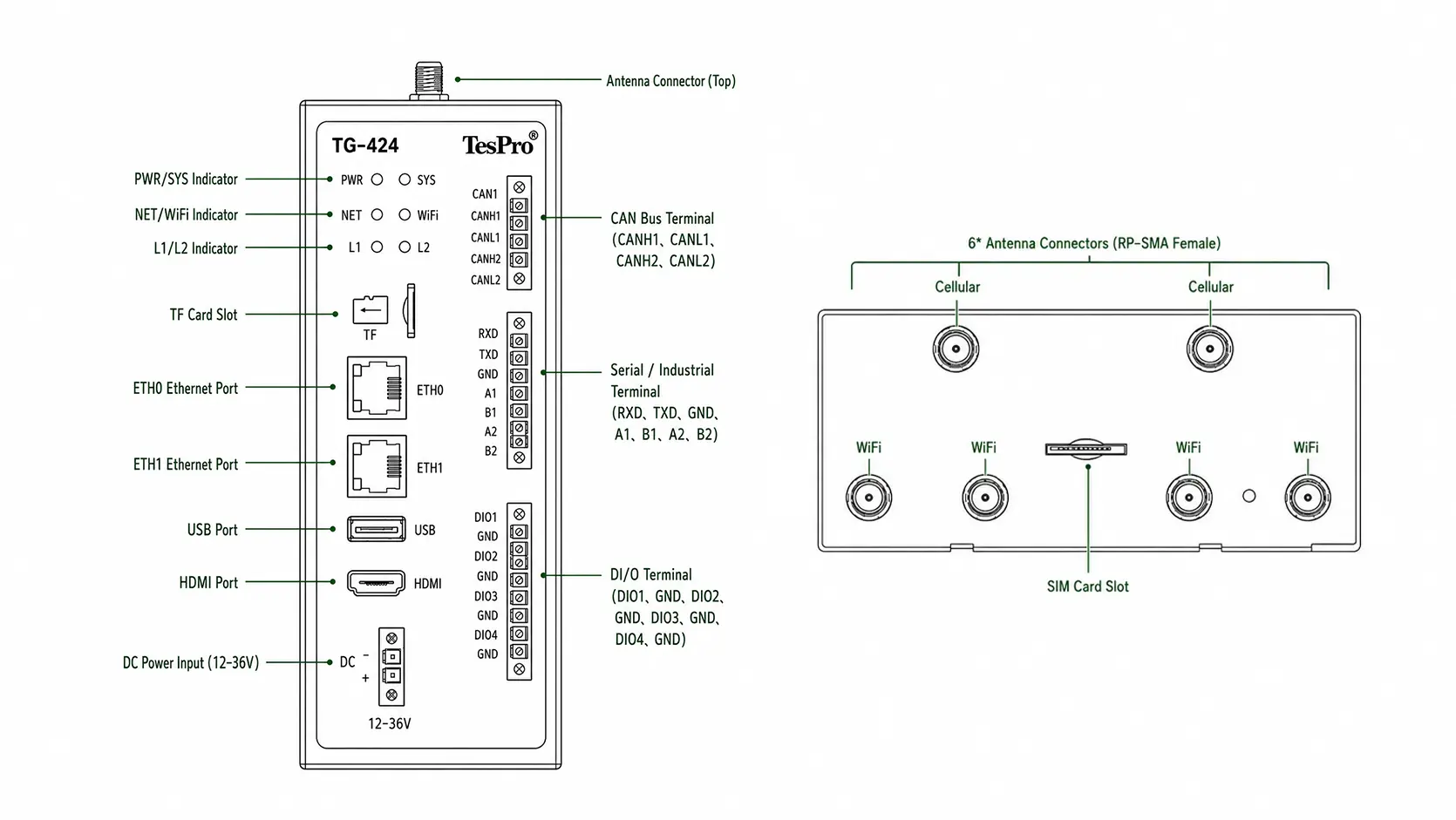
Interface Diagram
Dimensions Diagram
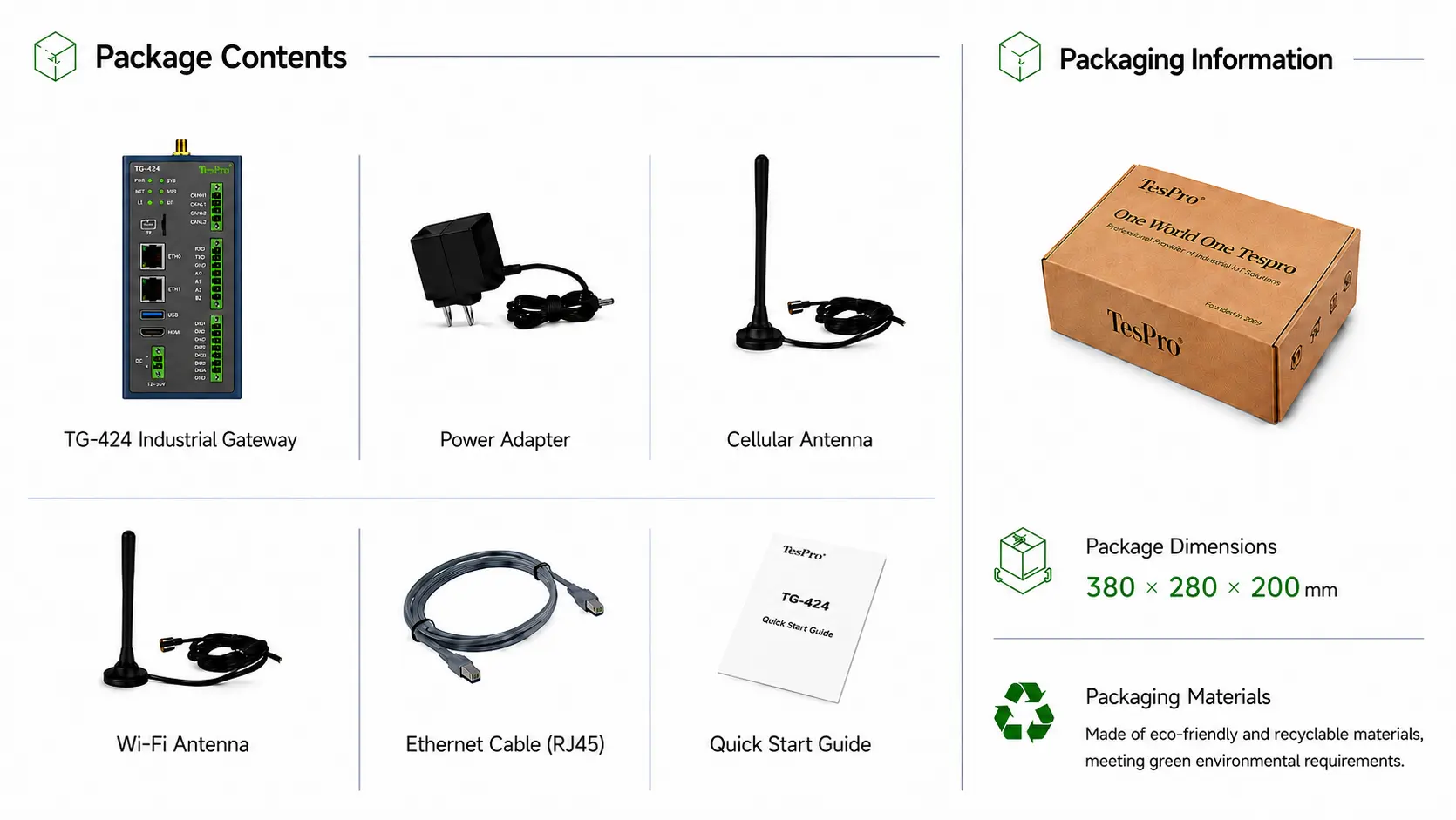
Accessories Diagram
Explore our Solutions
Smart Gateway for Multi-Device Protocol Integration
The Tespro edge gateway did protocol conversion (DLMS/Modbus/MQTT) and it could serve various communication chips such as RS485, 4G, and Wi-Fi. It served as a local data collection and forwarding center.
Download Materials


Frequently Asked Questions
To help you better understand our products' performance, compatibility, and usage, we’ve compiled answers to commonly asked questions. If your inquiry isn’t listed below, feel free to contact us directly for further assistance.
Contact Us
-
What is the maximum AI computing performance of the TG-400?

-
The TG-400 features a 6 TOPS integrated NPU and can be equipped with a 20 TOPS AI accelerator, providing up to 26 TOPS of aggregate heterogeneous computing performance.
-
Which industrial protocols does the TG-400 support?
-
It supports Modbus RTU, DL/T 645, IEC 62056-21, DLMS/COSEM, Siemens S7, Mitsubishi MC, Omron FINS, EtherNet/IP, EtherCAT, PROFINET, CAN and OPC UA.
-
What communication interfaces are available?
-
The TG-400 provides one RS232 port, two RS485 ports, two DI, two DO, USB 3.0, a Micro SD card slot and dual SIM card slots.
-
Which network connections does the TG-400 support?
-
It supports 2G, 3G, 4G and 5G RedCap cellular networks, with optional dual-band Wi-Fi, Bluetooth, LoRa and LoRaWAN connectivity.
-
Can the TG-400 process data locally?
-
Yes. It supports local data collection, protocol parsing, data conversion, storage, alarm evaluation and AI inference, reducing cloud traffic and improving response speed.
-
Where can the TG-400 be used?
-
It is suitable for smart power distribution, industrial automation, energy storage, environmental monitoring and smart city infrastructure applications.